Commercial epoxy flooring cost
Commercial epoxy flooring costs $5-$12 per sq ft installed, so a 2,000 sq ft shop runs $10,000-$24,000. What drives the number, and what downtime adds.
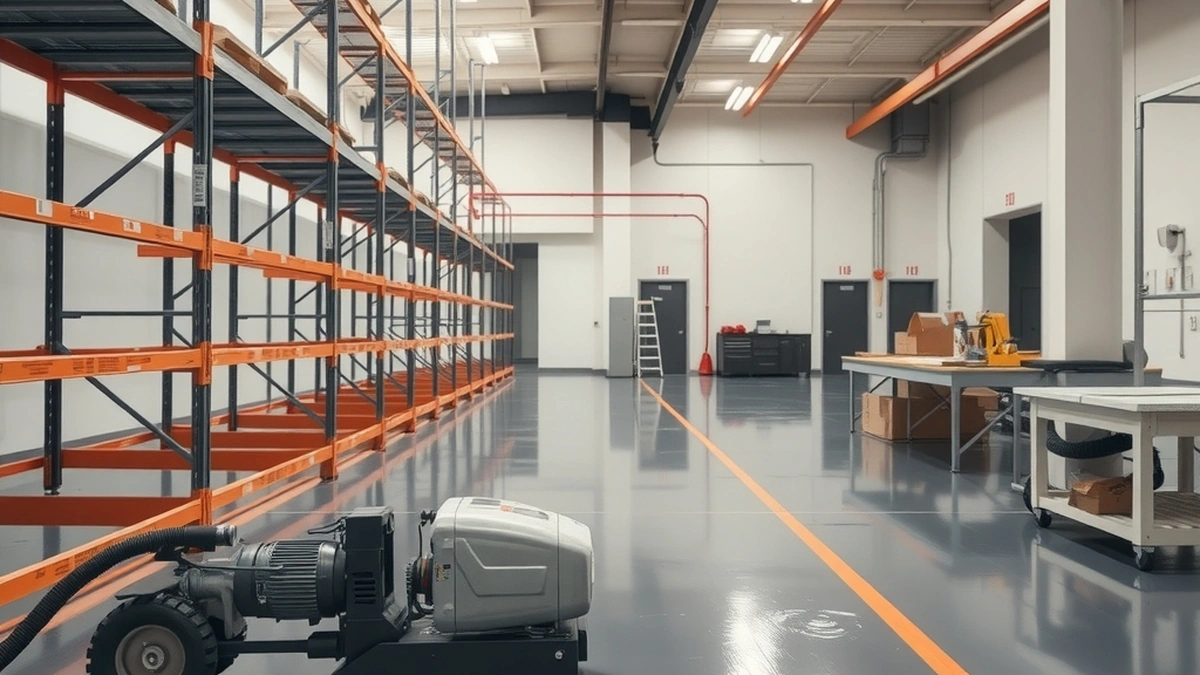
Commercial epoxy flooring costs $5 to $12 per square foot installed. On 2,000 sq ft that is $10,000 to $24,000; on 10,000 sq ft it is $50,000 to $120,000. Grinding adds $1 to $3 per square foot and moisture mitigation adds $2 to $5 where the slab fails a test.
- Installed rate
- $5 - $12 per sq ft
- 2,000 sq ft job
- $10,000 - $24,000
- Grinding
- $1 - $3 per sq ft
- Moisture mitigation
- $2 - $5 per sq ft
Some links on this page are affiliate links.If you buy through them we may earn a commission at no extra cost to you. We do not accept payment for rankings. Read the full disclosure.
Commercial epoxy flooring costs $5 to $12 per square foot installed, which puts a 2,000 sq ft shop floor at $10,000 to $24,000 and a 10,000 sq ft warehouse at $50,000 to $120,000. Material sold as a DIY kit runs $3 to $7 per square foot. The line that decides whether the project is worth doing is rarely the resin — it is the revenue the space loses while the floor cures.
What commercial epoxy flooring is
Commercial epoxy flooring is a resin system specified for foot and forklift traffic in retail, warehouse, shop and food-handling space, built from mechanical surface preparation, crack repair, a primer, a base coat with aggregate or flake, and a topcoat.
That definition matters because it is a system, not a product. A single coat of epoxy over a swept slab is a garage project. A commercial floor has a specified film thickness, a tested surface profile, a documented moisture result and a topcoat chosen for the chemicals the space actually sees.
The installed rate, line by line
The published rate hides four separate purchases. Ground and clean concrete is the first, and it is the one owners most often try to cut.
| Line item | Rate per sq ft | 2,000 sq ft | When it applies |
|---|---|---|---|
| Diamond grinding | $1 - $3 | $2,000 - $6,000 | Always |
| Crack and spall repair | Quoted per repair | $400 - $2,500 | Slabs with movement or damage |
| Moisture mitigation | $2 - $5 | $4,000 - $10,000 | Only after a failed test |
| Epoxy base and broadcast | $5 - $12 | $10,000 - $24,000 | Always |
| Polyaspartic topcoat | $8 - $15 system rate | $16,000 - $30,000 | High-traffic or fast return |
Read the fourth row as the system rate, not an add-on: $5 to $12 per square foot already includes primer, base and a standard topcoat on most commercial bids. The polyaspartic row replaces that rate rather than stacking on top of it.
Concrete grinding at $1 to $3 per square foot is not optional in a commercial setting. A coating bonded to a slab that was acid-etched instead of profiled will delaminate under forklift traffic, and the repair costs more than the grinding did. Moisture mitigation at $2 to $5 per square foot applies only when a test shows the slab is passing vapor, but on a 1970s slab that test is the difference between a $14,000 job and a $24,000 one.
Cost by building size
Square footage is the multiplier, and the rate compresses as the floor grows because mobilization, travel and setup are fixed.
| Floor area | Low ($5) | High ($12) |
|---|---|---|
| 1,000 sq ft | $5,000 | $12,000 |
| 2,000 sq ft | $10,000 | $24,000 |
| 5,000 sq ft | $25,000 | $60,000 |
| 10,000 sq ft | $50,000 | $120,000 |
The arithmetic is direct multiplication: 5,000 × $5 = $25,000 and 5,000 × $12 = $60,000. A 10,000 sq ft warehouse rarely pays the full $12 because a crew can run large open bays without the cutting-in that eats time in a small retail unit. A 1,000 sq ft stockroom rarely gets $5 because the crew still spends a day on mobilization and masking.
Add grinding to any of those totals: 10,000 sq ft × $1 = $10,000 at the low end and 10,000 × $3 = $30,000 at the high end. That is why a warehouse quote of $60,000 can be honest and still not cover the prep.
Why a shop floor is not a garage floor
Five cost drivers separate the two, and each one is a line a homeowner never sees.
Phasing. Retail and food space often has to stay open. Coating half the floor at a time doubles mobilization and leaves a cold joint that has to be detailed.
Out-of-hours labor. Night and weekend crews carry a wage premium, and the premium lands in the rate.
Chemical resistance. A shop that parks forklifts with hydraulic leaks, or a kitchen that hoses down, needs a topcoat rated for those exposures. That is a different product at a different price.
Slip resistance. Commercial floors are usually specified to a measured slip rating, which means aggregate in the topcoat and a test report.
Cove base and line marking. Four-inch coves, bollard rings and traffic lanes are priced per linear foot or per job, not per square foot, and they are routinely left out of a first bid.
The downtime calculation
This is the comparison that decides more commercial projects than price does: standard epoxy versus a polyaspartic topcoat.
A standard epoxy system needs three to five days before forklift traffic. A polyaspartic system can take light traffic in about 24 hours and full traffic the next day. Polyaspartic costs $8 to $15 per square foot against $5 to $12 for epoxy, so the premium is roughly $3 per square foot at the low end.
On 2,000 sq ft that premium is 2,000 × $3 = $6,000. If the floor earns $4,000 a day and the fast system saves two working days, the saving is 2 × $4,000 = $8,000. The expensive system is the cheaper project. If the space earns $400 a day, the same premium takes years to recover and standard epoxy wins.
Run that arithmetic on your own numbers before you look at the bids. It is the only comparison that uses your business rather than a national average.
How to compare commercial bids
- Require the moisture test result. ASTM F2170 in-situ relative humidity, with readings and locations attached to the bid. A bid without it is pricing a slab nobody has checked.
- Ask for the system in writing. Primer, base, broadcast, topcoat, film thickness per coat and product data sheets, not a brand name alone.
- Separate prep from coating. Grinding at $1 to $3 per square foot and repairs should appear as their own lines, so you can see what a competitor is omitting.
- Price the schedule, not just the floor. Days on site, cure window, when racks can return and who moves them.
- Check the warranty against the use. A five-year warranty on a decorative floor in a forklift aisle is not the same document as one that covers abrasive traffic.
What belongs in the specification
Write the spec before you collect prices: square footage, substrate condition, moisture result, system build, slip rating, cove details, line marking, cure window and the cleaning products the finished floor will tolerate. Then every bid prices the same floor.
For the per-square-foot mechanics behind these rates, read epoxy garage floor cost per square foot. If the floor has to return to service in a day, polyaspartic floor cost covers the premium and when it pays. For a smaller shop or a home garage, epoxy cost explains how kit pricing differs from a contracted system.
Frequently asked questions
What does commercial epoxy flooring cost per square foot?
Five to twelve dollars per square foot installed, including grinding, primer, a base coat and a topcoat. Chemical-resistant systems, cove base and line marking are quoted separately and push the figure toward the top of the range.
How much does a 5,000 sq ft warehouse floor cost?
Between $25,000 and $60,000 at $5 to $12 per square foot. Add $5,000 to $15,000 for grinding at $1 to $3 per square foot, and $10,000 to $25,000 if the slab needs moisture mitigation at $2 to $5.
Is epoxy cheaper than polished concrete for a shop?
The installed rates overlap, but they are different products. Epoxy gives you a seamless, cleanable surface and color; polished concrete gives you a mechanical finish with no coating to recoat. Compare them on maintenance, not on day-one price.
How long is a commercial floor out of service?
A standard epoxy system needs three to five days before forklift traffic, and a polyaspartic topcoat can return to light traffic in about 24 hours. Most commercial jobs are scheduled over a weekend or in overnight shifts.
Does the price include moving racks and equipment?
Usually not. Clearing the floor, protecting racking and relocating equipment are owner costs or separate line items. Ask for them in writing, because a full warehouse move can cost more than the coating.
Why do two bids for the same floor differ by thousands?
Film thickness, topcoat chemistry, the number of coats, surface profile and whether the slab is moisture-tested. A bid that omits a primer or a topcoat is a different system, not a discount on the same one.
Sources
Some links are affiliate links.If you buy through them we may earn a commission at no extra cost to you. We do not accept payment for rankings. Read the full disclosure.