Epoxy cost: what you actually pay
Epoxy costs $3-$7 per sq ft as a DIY kit and $5-$12 installed. What the rate includes, how coverage math works, and why two quotes for one garage differ.
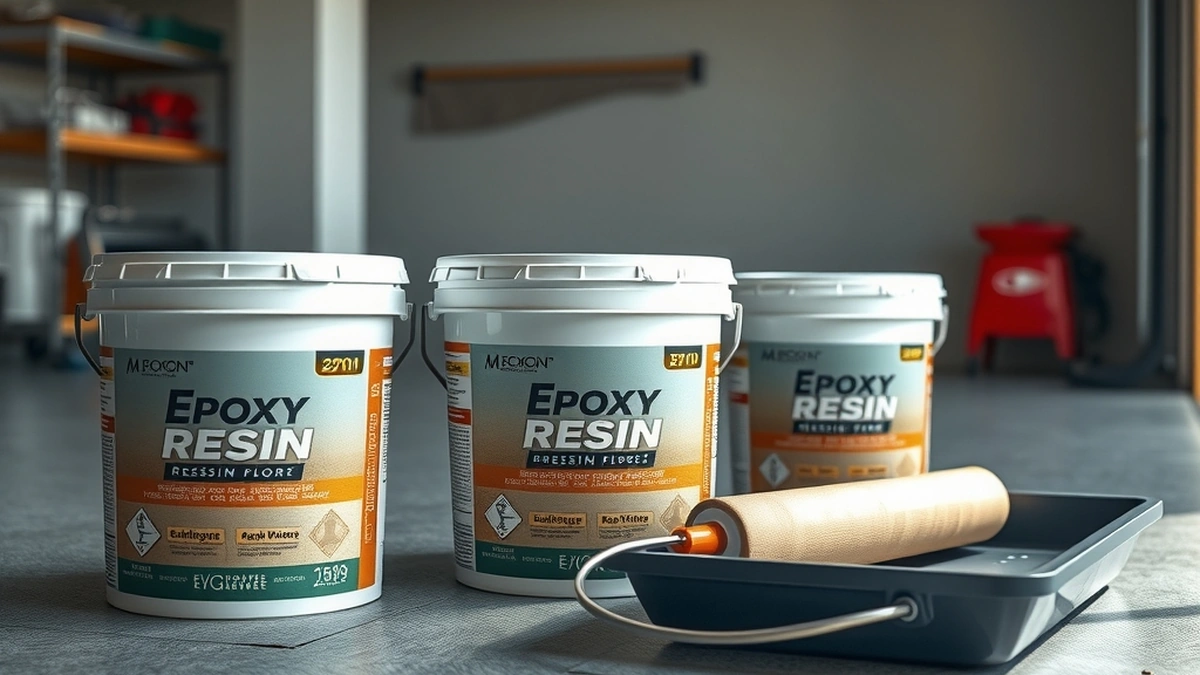
Epoxy costs $3 to $7 per square foot as a complete DIY materials budget and $5 to $12 per square foot installed by a contractor. On a 400 sq ft garage that is $1,200 to $2,800 DIY or $2,000 to $4,800 installed, before any slab repair or moisture mitigation.
- DIY materials
- $3 - $7 per sq ft
- Installed
- $5 - $12 per sq ft
- 400 sq ft DIY
- $1,200 - $2,800
- Grinding
- $1 - $3 per sq ft
Some links on this page are affiliate links.If you buy through them we may earn a commission at no extra cost to you. We do not accept payment for rankings. Read the full disclosure.
Epoxy costs $3 to $7 per square foot as a complete DIY materials budget and $5 to $12 per square foot installed by a contractor. On a 400 sq ft two-car garage that is $1,200 to $2,800 doing it yourself, or $2,000 to $4,800 hired out. Every other number in this article is built from those two rates plus the condition of the slab.
What the word “epoxy cost” covers
Epoxy cost is the total price of a resin floor system, measured either as materials for a DIY install or as a contracted rate that includes labor, prep and disposal.
The confusion starts because three different units get called “the cost.” A gallon price, a square-foot rate and a job total are not interchangeable, and a quote that mixes them is impossible to compare against another quote.
The $3 to $7 figure is a materials budget, not the price of one can. It includes primer, base resin, flake, clear topcoat, rollers, mixing buckets and usually a rented grinder. That is why it sits closer to the installed rate than homeowners expect.
The three numbers people confuse
| Unit | What it measures | Typical figure |
|---|---|---|
| Per gallon | One component, one container | Varies by solids content |
| Per square foot, DIY | Full materials budget for the project | $3 - $7 |
| Per square foot, installed | Materials, labor, prep, disposal | $5 - $12 |
| Per job | Square footage × rate, plus repairs | $1,200 - $4,800 on 400 sq ft |
A gallon price tells you nothing until you know the spread rate and the number of coats. A square-foot rate tells you nothing until you know what it includes. The job total is the only number that matters, and it is the last one to calculate.
Cost by product class
Not every product sold as epoxy is the same material, and the price tracks the solids content.
| Product class | Rate per sq ft | What it is |
|---|---|---|
| Water-based epoxy kit | $3 - $4 | Low solids, thin film, indoor use only |
| 100% solids epoxy kit | $4 - $7 | Full build, better chemical resistance |
| Professional epoxy install | $5 - $12 | Ground, primed, built and topcoated |
| Polyaspartic system | $8 - $15 | Fast cure, UV-stable clear |
| Metallic epoxy | $10 - $20 | Decorative pour with a clear topcoat |
Water-based products are the entry point and the most common source of disappointment. They are legitimate coatings for a utility room floor; they are a poor choice for a garage that sees road salt and hot tires. The solids content is the reason, and it is printed on the data sheet.
A 100% solids kit at $4 to $7 per square foot is the sensible DIY middle. It builds a film thick enough to wear and takes a topcoat without solvent shrinkage.
The coverage arithmetic
Coverage is where DIY budgets go wrong, and the error is always in the same direction: too little material.
- Measure the floor. A 20 ft × 20 ft garage is 400 sq ft.
- Add waste. Ten percent brings 400 sq ft to 440 sq ft of material to buy.
- Multiply by the number of coats. Two coats means 440 × 2 = 880 sq ft of coverage to purchase.
- Divide by the spread rate. If a kit covers 250 sq ft at the specified thickness, 880 ÷ 250 = 3.5 kits, so buy 4.
On 400 sq ft at $3 to $7 per square foot, the materials budget is 400 × $3 = $1,200 at the low end and 400 × $7 = $2,800 at the high end. A shortfall in the middle of a pour is not a small problem: the batch has to match, and a cold joint between mixes shows.
What gets added after the resin
Three lines sit outside the $3 to $7 rate and outside most advertised installed rates.
Grinding at $1 to $3 per square foot. On 400 sq ft that is $400 to $1,200, and it is not optional. A rented grinder plus diamonds usually lands near the bottom of that range for a homeowner.
Moisture mitigation at $2 to $5 per square foot. On 400 sq ft that is $800 to $2,000, and it applies only after a failed test. A plastic sheet taped down for 24 hours is a screening test; an in-situ relative humidity probe is the real one.
Repair and removal. Old coating, working cracks and spalls are priced per repair. Budget $0 to $2,400 on a typical older slab and treat anything above zero as a possibility rather than a surprise.
Add the low ends to a DIY job and 400 sq ft comes to $1,200 + $400 = $1,600. Add the high ends and it comes to $2,800 + $1,200 = $4,000. That is the same arithmetic the installed rate uses, which is why the two numbers converge.
Epoxy cost per year of service
The cheapest floor is not the one with the lowest invoice. Divide the total by the years it stays down.
A $1,200 water-based kit that needs replacement in four years costs $300 a year. A $4,000 professional system that goes fifteen years before a recoat costs about $267 a year, and it does not need a second round of prep. The cheap floor is more expensive per year and it costs a week of garage access each time.
Use your own expected service life rather than a marketing claim. The arithmetic is total cost ÷ years in service, and it changes the ranking more often than the day-one price does.
How to build a real number in six steps
- Measure every surface. Floor, apron and stem wall, then add 10%.
- Test moisture and note the result. A failed test adds $2 to $5 per square foot.
- List the defects. Cracks, oil, spalls, old coating, each with a photo.
- Choose the product class. Water-based, 100% solids or polyaspartic, and write down why.
- Price the full system. Primer, base, flake, topcoat and tools, not just the resin.
- Add a contingency. Ten percent on an older slab is cheaper than a stalled project.
For the line-by-line project total, epoxy garage floor cost is the companion piece. Garage floor epoxy kit covers what is actually in a box, and water-based epoxy garage floor explains where the cheap end of the range gives out.
If you are still deciding between hiring and doing it, DIY epoxy garage floor lists the tools and the days involved.
Frequently asked questions
How much does epoxy cost for a two-car garage?
One thousand two hundred to two thousand eight hundred dollars for a full DIY materials budget on 400 sq ft, or $2,000 to $4,800 installed. Grinding and any slab repair are separate lines.
Why is the DIY rate so close to the installed rate?
Because the DIY rate is a project budget, not a can of resin. It includes primer, base, flake, topcoat, rollers and usually a rented grinder. The contractor's advantage is labor efficiency and a warranty, not cheaper materials.
How much epoxy do I need for 400 square feet?
Work from the spread rate on the product data sheet, not from the square footage of the floor. Two coats at the stated coverage plus 10% waste on 400 sq ft is about 480 sq ft of material to buy.
Does epoxy cost more than polyaspartic?
Yes at the installed level. Epoxy runs $5 to $12 per square foot and polyaspartic $8 to $15, because polyaspartic resin costs more and cures fast enough for a one-day install.
Is a cheap epoxy kit a false economy?
Often. A thin water-based kit over an unprepared slab fails early, and the replacement costs the kit plus removal plus the prep you skipped. The savings are usually smaller than the second job.
What is not included in a per-square-foot epoxy rate?
Emptying the garage, structural crack repair, old coating removal, stem wall coating, disposal and the cost of being without the garage for the cure window.
Sources
Some links are affiliate links.If you buy through them we may earn a commission at no extra cost to you. We do not accept payment for rankings. Read the full disclosure.