Epoxy Garage Floor vs polyaspartic coating
Epoxy builds the base, polyaspartic takes the wear and the UV. Compare cost, cure time and yellowing to pick the right system for your garage.
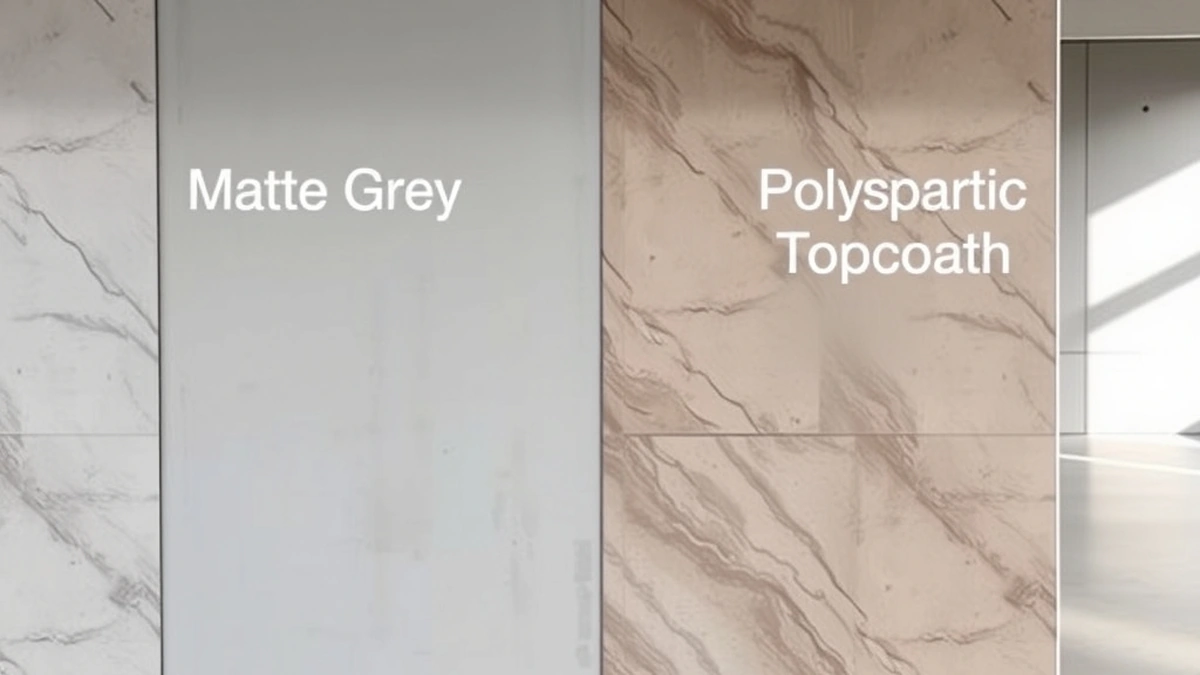
Epoxy is the cheaper, thicker base coat at $5-12 per sq ft; polyaspartic is the UV-stable, fast-curing topcoat at $8-15 per sq ft. Most durable residential systems use both — epoxy for build and color, polyaspartic for the wear layer.
- Professional epoxy
- $5-12 / sq ft
- Polyaspartic system
- $8-15 / sq ft
- DIY epoxy kit
- $3-7 / sq ft
- Metallic epoxy
- $10-20 / sq ft
Some links on this page are affiliate links.If you buy through them we may earn a commission at no extra cost to you. We do not accept payment for rankings. Read the full disclosure.
Epoxy and polyaspartic are not competitors so much as two layers of the same floor. Epoxy is the thicker, cheaper base coat that carries color and bonds to the concrete; polyaspartic is the aliphatic topcoat that takes abrasion, chemicals and sunlight without yellowing. The real decision is whether you need the topcoat, and that depends on sun exposure, downtime and budget.
What each coating actually is
An epoxy garage floor coating is a two-part thermosetting resin that cures by an addition reaction between resin and hardener, forming a rigid, chemically resistant film that bonds mechanically to a profiled slab.
Polyaspartic is a two-component aliphatic polyurea coating built on aspartate esters. It reacts fast, stays clear or color-stable under UV, and forms a more flexible film than a rigid epoxy. It is almost always sold as a topcoat or a full broadcast system rather than a build coat.
The practical difference: epoxy builds thickness cheaply, polyaspartic resists sunlight and cures quickly. Epoxy needs slab and air temperatures at 60°F and rising through the cure; polyaspartic tolerates colder conditions but demands more skill. Neither one fixes a wet slab, and neither one substitutes for diamond grinding.
The cost gap, in dollars
| System | Cost per sq ft | 400 sq ft | 600 sq ft |
|---|---|---|---|
| DIY epoxy kit | $3-7 | $1,200-2,800 | $1,800-4,200 |
| Professional epoxy | $5-12 | $2,000-4,800 | $3,000-7,200 |
| Polyaspartic system | $8-15 | $3,200-6,000 | $4,800-9,000 |
| Metallic epoxy | $10-20 | $4,000-8,000 | $6,000-12,000 |
Read the table by subtracting rows, not by comparing headlines. Polyaspartic at $8-15 versus epoxy at $5-12 leaves a gap of $3 per square foot at both ends: 400 × $3 = $1,200 on a two-car garage, and 600 × $3 = $1,800 on a three-car. That premium buys UV stability, faster return to service and a tougher wear layer.
The expensive mistake is buying the premium topcoat to compensate for cheap prep. Grinding at $1-3 per square foot and moisture mitigation at $2-5 per square foot are the line items that decide whether either coating stays bonded, and no topcoat can rescue a slab that failed a moisture test.
Cure time and how long the garage is out of service
Epoxy is slow. A typical 100% solids product gives 12 to 24 hours to foot traffic and 3 to 7 days before you park on it, and cool slabs stretch both numbers. Two coats plus a topcoat can mean the car sleeps outside for a week.
Polyaspartic is fast. Recoat windows often fall between 4 and 12 hours, foot traffic in 8 to 12 hours, and vehicle traffic in about 24. Some formulations can be applied at temperatures down to 20°F, which is why installers in cold climates favor them for winter work.
Pot life is the flip side of that speed. Epoxy usually gives a crew 20 to 40 minutes of working time at 70°F; polyaspartic can gel in 10 to 20, so it rewards two people rolling in sequence rather than one person working alone. Fast cure also means fast mistakes — a missed lap joint can be too hard to fix within the hour.
If the garage is your only parking and the forecast is rain for five days, the fast system is worth the premium on convenience alone. If you have a driveway and a free weekend, epoxy’s slower schedule costs you nothing but patience.
Yellowing, hot tires and UV
Standard epoxy ambers under ultraviolet light. The change is cosmetic, not structural — the film still protects the slab — but a south-facing apron will shift from grey to a warm tan within a couple of summers, and a light flake floor will look dingy next to the door.
Polyaspartic is aliphatic, which means its molecular structure absorbs UV without breaking down or shifting color. That is the single strongest argument for using it as the topcoat on any floor that gets direct sun.
Hot tire pickup is a separate problem and it is mostly about adhesion and cure, not chemistry. A fully cured, properly bonded floor resists tire plasticizers; a floor applied over a dusty or sealed slab does not, whatever the topcoat. See hot tire and flake problems if patches are already lifting.
What most installers actually sell
The standard residential system is a hybrid: grind, primer, epoxy base coat with a vinyl flake broadcast, then a polyaspartic topcoat. You get epoxy’s film build and low material cost with polyaspartic’s UV and abrasion performance.
The arithmetic explains the popularity. On 400 sq ft, an epoxy base at the low end of $5-12 costs $2,000; add a polyaspartic topcoat and the package lands inside the $8-15 band, or $3,200 to $6,000. A full polyaspartic build at the same size is not meaningfully cheaper and buys nothing extra in a garage that is mostly shaded.
Single-product systems exist too: all-epoxy floors for rentals and workshops, all-polyaspartic floors for commercial bays that cannot close for a week. Neither is wrong. They are just matched to different constraints.
Choosing between them in four steps
- Check the sun. Stand in the garage at 4 pm. If direct light hits the floor through the door or a window, plan on an aliphatic topcoat.
- Check the schedule. Count the days the cars can stay outside. Under three days, polyaspartic; a week or more, epoxy is fine.
- Check the slab. Test moisture and look for cracks, spalling and old sealer. Both systems need grinding at $1-3 per square foot, and both need mitigation at $2-5 if the slab reads wet.
- Price the hybrid first. Ask for an epoxy base with a polyaspartic topcoat and compare it against an all-polyaspartic quote for the same square footage. The hybrid usually wins on value.
A floor is a system, not a resin. Compare epoxy garage floor cost per square foot before you choose a brand, check how long epoxy garage floor lasts if service life is the deciding factor, and read garage floor painting vs epoxy if you are still weighing a paint-on alternative.
Frequently asked questions
Can you put polyaspartic directly over epoxy?
Yes, and it is the standard detail. The epoxy must be within its recoat window or abraded first, clean and fully cured enough to accept the next coat without solvent trapping.
Does polyaspartic yellow in the sun?
Not like epoxy. Polyaspartic is aliphatic and holds color far better under UV, which is why it is used as the topcoat on garage doors that face the sun all afternoon.
Which one is cheaper per square foot?
Epoxy. A professional epoxy system runs $5 to $12 per square foot, while a polyaspartic system runs $8 to $15. On 400 sq ft the gap is $1,200 to $1,600 at the middle of both ranges.
How fast can I drive on polyaspartic?
Many products accept vehicle traffic in 24 hours, versus 3 to 7 days for standard epoxy. Read the data sheet, because thickness and slab temperature move both numbers.
Is polyaspartic harder to install?
Yes. Pot life can be as short as 10 to 20 minutes and the material skins fast, so it punishes slow rolling and poor planning. Most failures are applicator errors, not product defects.
Can I use epoxy alone in a garage?
Yes, if the floor never sees direct sun and you accept some ambering. Add a polyaspartic or aliphatic urethane topcoat if the door faces south or west, or if the floor sees de-icing salt.
Sources
Some links are affiliate links.If you buy through them we may earn a commission at no extra cost to you. We do not accept payment for rankings. Read the full disclosure.