Garage Floor Painting vs Epoxy: Which Lasts Longer?
Compare garage floor painting and epoxy coatings for durability, cost, and prep requirements before you buy.
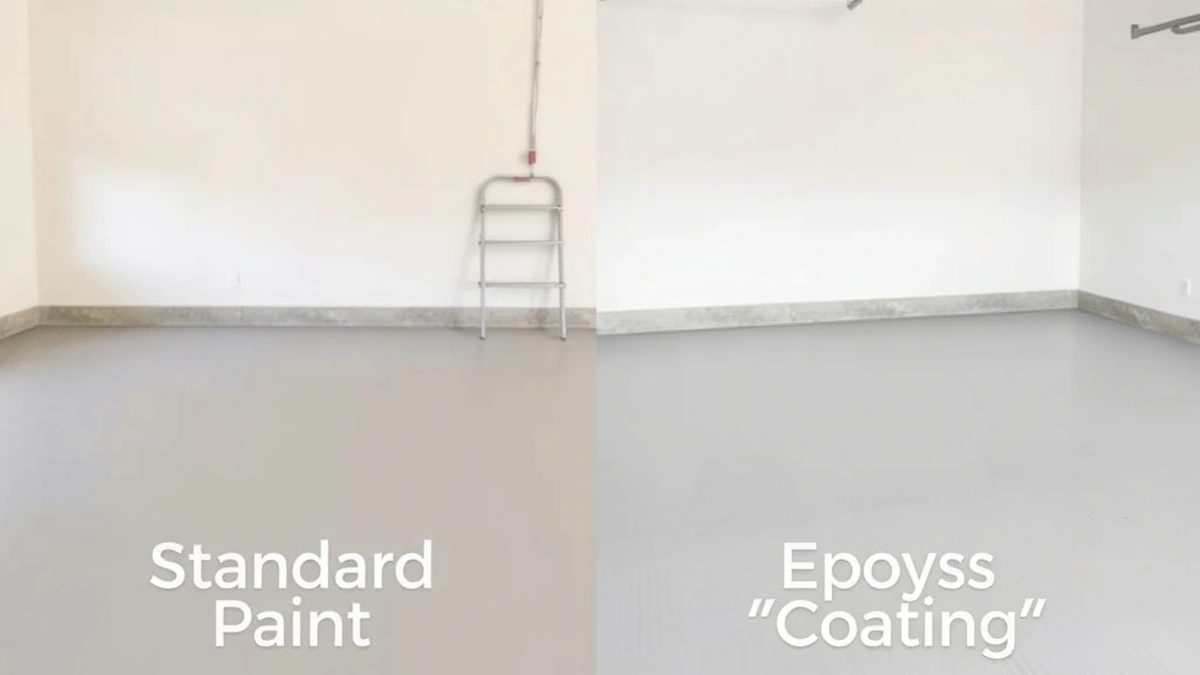
Epoxy outperforms standard garage floor painting in durability, chemical resistance, and wear life. Paint is cheaper upfront but usually peels within 1–3 years on active garage floors.
- Best for low budget
- Garage floor painting
- Best for durability
- Epoxy coating
- Typical DIY epoxy cost
- $3–$7 per sq ft
- Professional epoxy cost
- $5–$12 per sq ft
- Expected paint life
- 1–3 years
Some links on this page are affiliate links.If you buy through them we may earn a commission at no extra cost to you. We do not accept payment for rankings. Read the full disclosure.
Garage floor painting and epoxy coating are not the same product, and they do not perform the same way. Paint is a thin, decorative film that sits on top of concrete. Epoxy is a resinous coating that bonds to the substrate and builds a much thicker wear layer. For most working garages, epoxy lasts longer and resists hot tires, chemicals, and abrasion far better than standard garage floor painting.
What Garage Floor Painting Actually Is
Garage floor paint is usually a latex or acrylic floor enamel sold for concrete and masonry. It goes on with a roller, dries quickly, and costs very little per square foot. The appeal is obvious: low upfront cost and fast application.
The downside is just as obvious. Paint forms a film on the surface rather than chemically bonding into the concrete pores. On a garage floor that sees vehicle traffic, that film is exposed to hot tires, oil drips, road salt, and abrasion from tires and foot traffic. Hot-tire pickup—where soft paint lifts off when tires cool and contract—is a common failure mode. In an active two-car garage, painted concrete often begins to peel or wear through within 1 to 3 years.
Paint can make sense for low-traffic storage areas, rental units, or homeowners who plan to recoat every couple of years. It is not a long-term floor system.
What Epoxy Coating Is
Epoxy is a two-part system consisting of a resin and a hardener. When mixed, they cure into a hard, cross-linked polymer that adheres to properly prepared concrete. The resulting film is much thicker than paint—often several mils to tens of mils depending on the product and number of coats.
That thickness creates real advantages. Epoxy resists abrasion, impacts, and many automotive fluids better than standard floor paint. It also tolerates cleaning with degreasers and pressure washing without wearing away as quickly. A properly installed epoxy floor can last many years before showing significant wear, though exact life depends on traffic, prep quality, and maintenance.
Epoxy is not invincible. It can chip under heavy impact, yellow under UV exposure if it is not UV-stable, and it will not stop moisture vapor moving through a slab from below. If your concrete has high moisture transmission, epoxy can blister or delaminate regardless of how well you applied it.
Cost Comparison With Real Numbers
Cost is usually the first thing homeowners compare, but the math only works if you include prep and expected service life.
For a typical 20-foot by 20-foot garage, you have 400 square feet of floor area.
Garage floor painting estimate Materials for standard concrete floor paint might run $0.50 to $1.50 per square foot. For 400 square feet, that is roughly $200 to $600 in materials. Labor, if hired, could add another $1 to $3 per square foot, or $400 to $1,200. Total installed cost might land between $600 and $1,800. Because paint may need replacement every 1 to 3 years, a 10-year cost could easily repeat that expense three or more times.
DIY epoxy kit estimate A DIY epoxy kit typically costs $3 to $7 per square foot. For 400 square feet, materials alone run $1,200 to $2,800. You also need to factor in prep supplies such as degreaser, etching solution or rental of a grinder, and possibly concrete repair filler.
Professional epoxy estimate Professional installation generally runs $5 to $12 per square foot. For 400 square feet, that is $2,000 to $4,800. That price usually includes surface preparation, moisture testing, primer, base coat, optional broadcast flakes, and topcoat.
Additional prep costs Concrete grinding, when needed for proper adhesion, typically adds $1 to $3 per square foot. For 400 square feet, that is $400 to $1,200. Moisture mitigation, if testing shows high vapor transmission, typically adds $2 to $5 per square foot, or $800 to $2,000 for the same garage.
These figures are estimates. Actual pricing varies by region, product selection, slab condition, and contractor.
Prep and Moisture Come First
This is where most DIY projects fail. Neither paint nor epoxy will stick to dusty, oily, or laitance-covered concrete. The surface must be clean, dry, and mechanically profiled so the coating has something to grip.
Acid etching is a common DIY prep method, but it is less reliable than mechanical grinding or shot blasting. Etching can leave residue if not rinsed thoroughly, and it does not remove oil stains or cure soft concrete. Grinding opens the concrete profile and removes weak surface layers, which is why professionals often prefer it.
Moisture testing matters too. Concrete slabs on grade can transmit water vapor from the soil below. If you coat a damp slab with a non-breathable epoxy, that vapor has nowhere to go and can push the coating off in blisters. A calcium chloride test or relative humidity probe test should happen before you buy product. If moisture levels are high, a moisture mitigation system is required first, adding $2 to $5 per square foot to the project.
Skipping prep to save money almost always costs more in the long run because the coating fails and has to be stripped and reapplied.
Durability and Wear Differences
Standard garage floor painting is a sacrificial layer. It sacrifices itself to protect the concrete underneath, but it sacrifices quickly. Tire marks, oil stains, and salt residue show up fast. Hot tires can soften and lift paint where the car sits nightly.
Epoxy builds a harder surface. It resists scuffing from tires and foot traffic, and spills can usually be wiped up before they stain. That said, epoxy is not maintenance-free. It still needs regular sweeping and occasional mopping with a neutral cleaner. Harsh solvents or abrasive scrubbing pads can dull the finish over time.
If you want maximum chemical resistance or faster return to service, polyaspartic systems are another option, typically priced $8 to $15 per square foot installed. Metallic epoxy systems run $10 to $20 per square foot and are primarily decorative. Those are premium upgrades, not necessities for a standard garage.
Where Each Option Makes Sense
Choose garage floor painting if:
- The garage sees light use and no daily vehicle traffic
- You need the lowest possible upfront cost
- You plan to sell or renovate soon and do not care about long-term wear
- You are willing to recoat every few years
Choose epoxy if:
- You park vehicles inside daily
- You want a floor that holds up to oil, salt, and cleaning
- You are prepared to invest in proper surface prep and moisture testing
- You want a finish that lasts years rather than seasons
For homeowners who want the look of epoxy without the full professional price, a DIY kit can work, but only if you follow prep instructions exactly and respect mixing and application windows. Rushing the process is the most common reason DIY epoxy fails.
Maintenance Expectations
Painted floors show wear quickly and often require touch-ups or full recoating within a few years. Sweep regularly, clean spills immediately, and avoid dragging heavy objects across the surface.
Epoxy floors last longer but still need care. Sweep or dust mop weekly to remove grit that acts like sandpaper under tires. Mop with a mild cleaner and water as needed. Avoid citrus cleaners or vinegar-based products on some epoxy formulations, as acids can dull the finish over time. Place mats at entryways to reduce salt and moisture tracking in winter.
If an epoxy floor does chip or wear through in high-traffic zones, spot repairs are possible but visible. Blending a repair into an older coat is difficult because the surrounding material has already aged and yellowed slightly.
Bottom Line
Garage floor painting costs less upfront but rarely survives daily garage use for more than a few years. Epoxy costs more to install—$3 to $7 per square foot for DIY kits and $5 to $12 per square foot professionally—but delivers a thicker, tougher surface that stands up to tires, fluids, and cleaning. Before either product goes on the floor, prep the concrete properly and test for moisture. A cheap coating over a poorly prepared slab is always expensive in the end.
For more detail on epoxy pricing, see our breakdown of how much an epoxy garage floor costs. If you are deciding between water-based and solvent-based products, our guide to water-based epoxy garage floor covers the trade-offs. For finishing options after the base coat, read about epoxy garage floor topcoat.
Frequently asked questions
Is garage floor painting cheaper than epoxy?
Yes. Standard porch and floor paint often runs well under $1 per square foot for materials, while a DIY epoxy kit typically costs $3–$7 per square foot installed.
How long does garage floor paint last?
On an active garage floor, standard paint commonly shows hot-tire pickup and peeling within 1–3 years, especially without proper concrete prep.
Can I paint over existing epoxy?
Not reliably. Coatings bond best to properly prepared concrete, and paint over cured epoxy often delaminates because the surface is too smooth.
Does epoxy stop moisture in concrete?
No. Epoxy is not a moisture barrier. If your slab has high moisture vapor transmission, you need moisture mitigation first, estimated at $2–$5 per square foot.
Is concrete grinding required before epoxy?
Mechanical prep such as grinding or shot blasting is strongly recommended for adhesion and typically adds $1–$3 per square foot when done professionally.
Can I apply epoxy myself?
Yes. DIY epoxy kits exist, but success depends heavily on surface prep, mixing ratios, temperature, and working within the product’s pot life.
Sources
Some links are affiliate links.If you buy through them we may earn a commission at no extra cost to you. We do not accept payment for rankings. Read the full disclosure.