Metallic pigment cost
What metallic pigment adds to an epoxy floor, with per-square-foot rates, a worked 400 square foot estimate, and the prep costs that decide the finish.
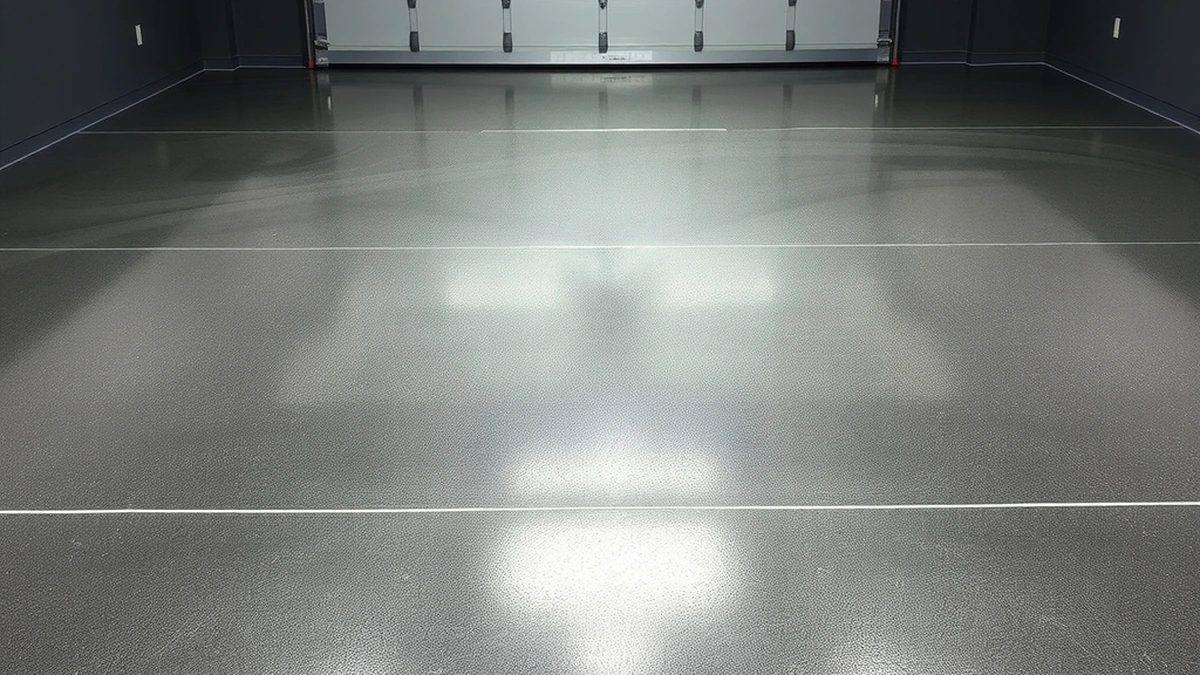
Metallic epoxy runs about $10 to $20 per square foot installed, against $5 to $12 for a standard epoxy floor. The pigment itself is a small part of that gap; most of it is the extra labor, mixing skill, and clear topcoat the finish requires.
- Installed range
- $10 - $20 per square foot
- Standard epoxy
- $5 - $12 per square foot
- Grinding add-on
- $1 - $3 per square foot
- Moisture mitigation
- $2 - $5 per square foot
Some links on this page are affiliate links.If you buy through them we may earn a commission at no extra cost to you. We do not accept payment for rankings. Read the full disclosure.
Metallic pigment cost shows up as a $10 to $20 per square foot installed price, roughly double the $5 to $12 range for a standard epoxy floor. The pigment powder itself is not the expensive part. The difference is labor: metallic systems are poured and moved while wet, require careful mixing and blending, and need a clear topcoat that a basic flake floor can sometimes skip.
What you are paying for
A metallic epoxy floor is a self-leveling epoxy base with a metallic pigment blended in, poured onto a prepared slab and worked with a roller, squeegee, or spike roller to create movement in the film. The metallic particles settle and orient as the epoxy cures, which is what produces the depth and the shifting pattern.
The pigment is a small percentage of the material cost. The premium is in the process: small batches mixed to a precise ratio, a floor poured and spread in one continuous operation, and a clear topcoat applied after cure to protect the finish and add UV stability.
Cost per square foot, line by line
| Component | Rate | Notes |
|---|---|---|
| Diamond grinding | $1 - $3 / sq ft | Required for any epoxy bond |
| Crack and spall repair | Per repair | Epoxy patch, cured before coating |
| Moisture mitigation | $2 - $5 / sq ft | Only where the slab needs it |
| Metallic epoxy base | $10 - $20 / sq ft | Includes pigment, pour, and finishing labor |
| Clear topcoat | Included in system price | Polyurethane or polyaspartic |
| Floor leveling or skim coat | Quoted per project | Needed on wavy or pitted slabs |
The metallic base rate already carries most of the labor. Grinding and moisture work sit outside it and apply to every epoxy system, which is why the cheapest metallic quote you will see is still above the top of the standard epoxy range.
The arithmetic on a 400 square foot garage
Take a 400 square foot two-car garage. At the low end, $10 per square foot is 400 × $10 = $4,000. At the high end, $20 per square foot is 400 × $20 = $8,000.
Add grinding at $2 per square foot: 400 × $2 = $800. Add three crack repairs at $75 each: $225. The low-end total becomes $5,025; the high-end total becomes $9,025.
If the slab returns high moisture readings, mitigation at $3.50 per square foot adds 400 × $3.50 = $1,400. That pushes the low end to $6,425 and the high end to $10,425.
Compare that with standard epoxy at $8 per square foot: 400 × $8 = $3,200, plus the same $800 grinding and $225 in repairs, for $4,225. The metallic finish adds $4,800 at the low end of its range on this floor. That premium buys appearance, not additional wear resistance.
Why labor dominates the price
Metallic epoxy is a wet-process finish. The installer pours ribbons of pigmented epoxy across the floor and works them together with a squeegee and a spike roller while the material is still liquid. The pattern forms in a window of minutes, and once the epoxy starts to gel, the surface cannot be reworked.
That means two or three people on a larger floor, moving in a coordinated line, with batches mixed just ahead of the pour. A crew that loses the wet edge gets a visible seam. A crew that mixes too far ahead gets a batch that kicks in the bucket.
The skill requirement is why the labor share is high. A standard epoxy base can be rolled in sections and touched up at the edges. A metallic pour cannot.
What can add to the bill
Slab flatness is the most common surprise. A metallic film is glossy and reflective, and it telegraphs every dip and ridge. A floor that looked acceptable under a car will look wavy under a mirror finish. A skim coat or grinding pass to flatten high spots can add a line item that was not in the original estimate.
Moisture is the second. A metallic floor over a slab with no vapor barrier will blister, and the blisters are far more visible on a mirror finish than on a flake floor.
Access is the third. Carrying buckets and equipment through a finished basement or around a tight corner adds labor hours that a per-square-foot rate does not capture.
Is the premium worth it?
If the garage is a showroom, a workshop that clients see, or a space where the floor is part of the design, the answer is usually yes. If it is a working garage that will hold two daily drivers, a flake broadcast floor at $5 to $12 per square foot gives comparable wear resistance for less money and hides dust better.
The metallic finish is also less forgiving in maintenance. Swirls and tire marks show on a high-gloss floor, and the clear topcoat has to be kept intact because a worn spot is far more obvious than on a textured surface. That maintenance reality belongs in the decision, not just the install price.
How to budget the job
- Measure the slab and calculate square footage; a 20 by 20 garage is 400 square feet.
- Multiply by the metallic range: 400 × $10 to 400 × $20 gives $4,000 to $8,000.
- Add grinding: 400 × $1 to 400 × $3 gives $400 to $1,200.
- Add mitigation only if the moisture test calls for it: 400 × $2 to 400 × $5 gives $800 to $2,000.
- Add repair and leveling allowances, then compare the total with a standard epoxy quote.
Run the same numbers against the metallic epoxy cost breakdown and the standard epoxy rates so the premium is visible rather than implied. Before approving the finish, read the metallic pigment problems guide, because most of the complaints about these floors are visible in the first week and trace back to pour timing or moisture.
Frequently asked questions
Why is metallic epoxy so much more expensive?
The pigment is a small line item. The cost is in the labor: mixing small batches, pouring and spreading a self-leveling film, and moving fast enough to keep a wet edge across the floor.
How much pigment does a floor need?
Coverage depends on the system, but metallic pigment is typically dosed per gallon of epoxy rather than per square foot, and the ratio is set by the manufacturer.
Does metallic epoxy need a topcoat?
Yes. Metallic floors are almost always finished with a clear polyurethane or polyaspartic topcoat, which is part of the $10 to $20 per square foot range.
Can metallic epoxy be installed over an existing floor?
Only over a sound, well-bonded coating that has been ground and cleaned. Loose or peeling material has to be removed first, which adds grinding at $1 to $3 per square foot.
What size floor is realistic for a first attempt?
Under 200 square feet is manageable for an experienced DIY installer. Above that, the wet edge and mixing timing become hard to control alone.
Does the finish hide imperfections?
It does the opposite. A glossy metallic film reflects light and shows every undulation in the slab, so floor leveling or a skim coat may be needed before coating.
Sources
Some links are affiliate links.If you buy through them we may earn a commission at no extra cost to you. We do not accept payment for rankings. Read the full disclosure.