Metallic pigment problems
The defects that show up on metallic epoxy floors: fish eyes, seams, cloudiness, blisters and color separation, with causes and what can be fixed.
Most metallic pigment problems are process faults: fish eyes from contamination, visible seams from a lost wet edge, cloudiness from overworking, and blisters from slab moisture. Only blisters and delamination are usually fatal.
- Most common defect
- Visible pour seams
- Most serious defect
- Blistering from slab moisture
- Fixable by sanding
- Fish eyes, cloudiness, lap marks
- Not fixable by topcoat
- Delamination and hollow spots
Some links on this page are affiliate links.If you buy through them we may earn a commission at no extra cost to you. We do not accept payment for rankings. Read the full disclosure.
Metallic pigment problems are almost always application problems. The pigment is stable and the chemistry is well understood, so when a floor goes wrong the cause is usually contamination on the slab, a lost wet edge during the pour, overworking the film, or moisture coming up through the concrete. Knowing which defect you are looking at tells you whether it can be repaired or has to be cut out.
The defect list
| Defect | Appearance | Usual cause |
|---|---|---|
| Fish eyes | Small craters with raised rims | Oil, silicone, or dust contamination |
| Pour seams | Straight lines where batches met | Lost wet edge during the pour |
| Cloudiness | Flat, milky areas in the pattern | Overworking the film |
| Blisters | Raised bubbles, soft when pressed | Moisture vapor through the slab |
| Color separation | Pigment settled in streaks | Pigment not fully dispersed |
| Delamination | Hollow, drummy areas | Poor bond from inadequate grinding |
Each one has a different prognosis. Fish eyes and cloudiness are cosmetic and can be sanded and recoated. Seams are cosmetic but harder to hide. Blisters and delamination are structural failures of the coating system and cannot be fixed with a topcoat.
Contamination and fish eyes
A fish eye is a crater where the epoxy pulled away from a low-surface-energy spot. Silicone, oil, grease, mold release agents, and even some dust particles cause it. The coating flows away from the contamination and cures with a rim around a bare center.
Prevention is cleaning discipline. Grind, vacuum with a HEPA filter, then wipe with a compatible solvent and let it flash off. Do not use a household cleaner with a silicone additive, and do not let a roller cover that has been stored in a dusty shop touch the floor. Nitrile gloves matter here; skin oils transfer to the slab and to the roller.
Small fish eyes can be sanded flat and recoated. A floor covered in them usually needs to be ground back and repoured, because chasing individual craters leaves a visible map.
Seams, laps, and the wet edge
Metallic epoxy is poured and spread in one continuous operation for a reason. The pattern is created by the movement of pigment in a wet film, and two batches poured at different times meet at a line that never blends.
On a 400 square foot floor, the pour has to move faster than the material gels. In warm conditions that window can be 20 minutes. A crew that stops to mix a new batch without a second person continuing the pour will produce a seam.
A light seam can be sanded and recoated, but sanding removes the metallic effect at that line, so the repair is visible under direct light even when the surface is flat. The practical answer is to plan the pour so the whole floor is one operation, with batches mixed ahead and staged.
Cloudiness and overworking
The metallic look depends on pigment orientation. When the installer keeps rolling or squeegeeing the film, the pigment disperses evenly and the floor turns into a flat, cloudy color with no depth.
The technique is counterintuitive: pour, spread once to the edges, then leave it. A spike roller is used lightly to release trapped air, not to mix. Floors that look muddy usually have been worked for too long by an installer worried about coverage.
Cloudiness cannot be sanded out, because the pigment is distributed through the film. It can be recoated with a new metallic pass after grinding, which is effectively a do-over.
Blisters and moisture
A blister is a raised bubble with a soft top, and it means water vapor is pushing up from the slab. The coating has bonded to the concrete, but the vapor pressure behind it exceeds the bond strength.
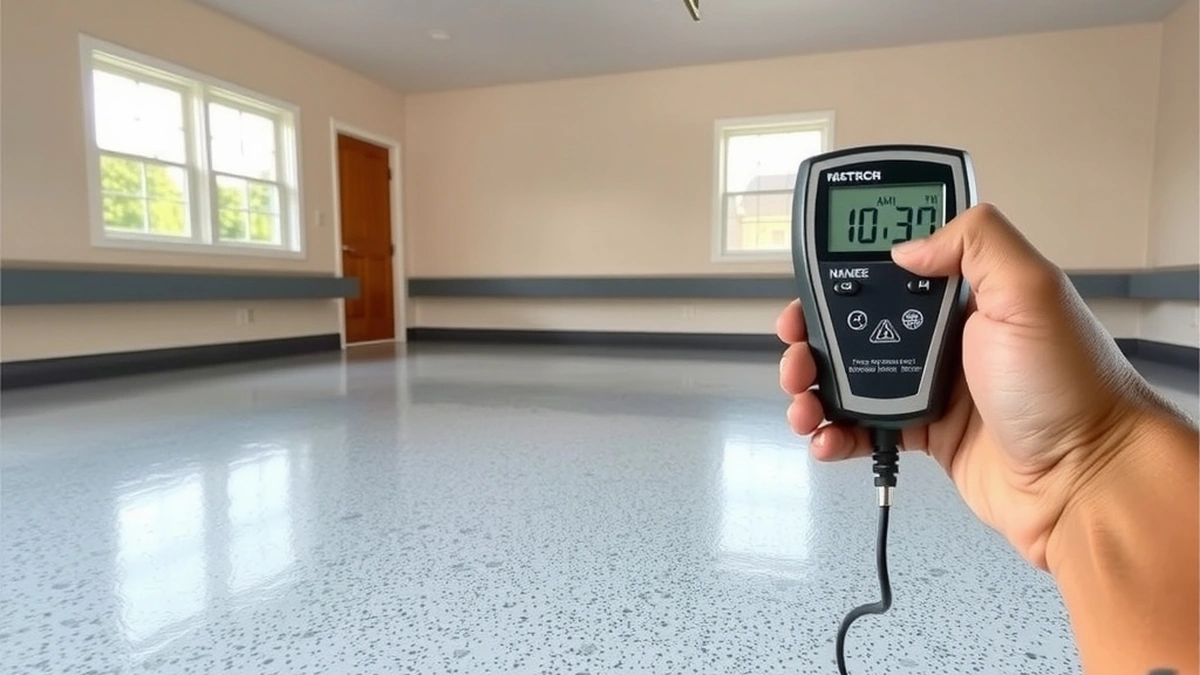
This is why moisture testing comes before product selection. A slab without a vapor barrier can emit enough vapor to lift any coating, metallic or not. Mitigation at $2 to $5 per square foot is the standard remedy, applied before the decorative layer.
Blisters that appear within days are usually moisture. Blisters that appear after a heating season can also be moisture, driven by the temperature differential. Either way, sanding and recoating the blistered area without addressing the source will produce new blisters in the same place.
Diagnosing what you are looking at
- Press the defect with a thumb; a soft, yielding bubble is a blister, a hard crater is a fish eye.
- Tap the area with a coin; a hollow sound indicates delamination.
- Look at the defect under a straight edge or bright light at a low angle to see whether the film is flat or raised.
- Check the pattern of the defects; clusters near a wall point to edge prep, random spots point to contamination.
- Note when they appeared: during the pour, within a week, or after a season.
That sequence separates a cosmetic issue from a bond failure, which determines whether the fix is a sanding pad or a grinder.
Repair or replace
Cosmetic defects in a small area can be spot repaired. Grind the affected patch, clean it, re-prime, repour a small metallic batch, and blend the edges. The repair will be visible under raking light but acceptable in normal use.
Bond failures are different. If more than a small fraction of the floor is hollow, the system has to come off. Grinding a full floor at $1 to $3 per square foot is 400 × $2 = $800 on a 400 square foot garage before any new material, which is why the moisture test at the start is the cheapest line item in the project.
For the cost of a full metallic system, see the metallic pigment cost breakdown. For the pour sequence that avoids seams, read the installation method. And if the floor is already down and only dull or scratched, the maintenance guide covers what can be restored without a repour.
Frequently asked questions
Why does my metallic floor have small craters?
Those are fish eyes, caused by oil, silicone, or dust on the slab or in the roller cover. The coating pulls away from the contaminated spot and leaves a crater.
Can visible seams be removed?
Sometimes. A light seam can be sanded flat and recoated. A seam where the epoxy cured at two different heights usually needs the area ground back and repoured.
Why does the metallic pattern look cloudy?
Overworking the film with a roller or squeegee mixes the pigment evenly and kills the movement. The pattern forms when the material is poured and left mostly alone.
What causes white patches under a metallic floor?
Moisture vapor pushing through the slab, or amine blush from a poorly mixed batch. Both show as cloudy white areas that do not sand out.
Will a topcoat hide a defect?
No. A clear topcoat is transparent, so every defect underneath stays visible and often becomes more obvious because the gloss reflects light.
How soon do defects appear?
Fish eyes and seams are visible during the pour. Blisters usually appear within days to weeks, and delamination can take a full heating season to show.
Sources
Some links are affiliate links.If you buy through them we may earn a commission at no extra cost to you. We do not accept payment for rankings. Read the full disclosure.