Polyurethane vs Flake broadcast
A clear urethane wear layer against a flake broadcast finish: what each protects, how they combine, and which garage floor benefits from which.
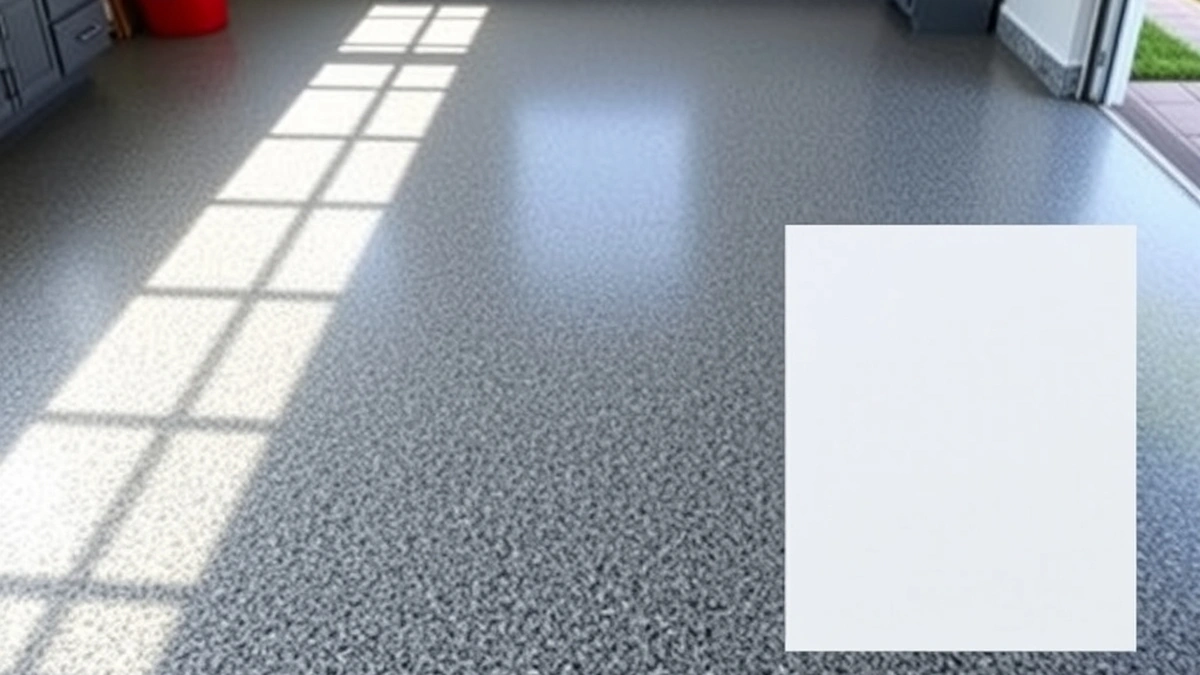
Polyurethane is a clear wear layer; flake broadcast is a decorative finish. They work together: flake is broadcast into an epoxy base and sealed under a polyurethane topcoat. On its own, a urethane clear gives a smooth floor; flake gives texture and hides dirt.
- Urethane role
- Clear wear layer
- Flake role
- Decorative broadcast
- Combined cost
- $5 - $12 per square foot
- Topcoat rate
- Upper part of the range
Some links on this page are affiliate links.If you buy through them we may earn a commission at no extra cost to you. We do not accept payment for rankings. Read the full disclosure.
Polyurethane and flake broadcast are not alternatives: one is a clear wear layer, the other is a decorative finish. A flake floor is built by broadcasting vinyl chips into an epoxy base and sealing them under a topcoat, and an aliphatic polyurethane is the best of those topcoats. A urethane clear without flake gives a smooth floor with the same protection.
What each contributes
Polyurethane contributes the wear surface. It is a thin, clear film at 3 to 6 mils that resists abrasion, UV and hot tires, and it protects whatever is underneath.
Flake contributes appearance and texture. The vinyl chips create a speckled pattern that hides dust and small defects, and the texture adds grip underfoot.
The two are complementary. The flake gives the floor its look; the urethane gives it its life. Specify one without the other and the result is either a decorative surface that wears through or a protective film with no pattern.
Side by side
| Trait | Urethane clear | Flake broadcast |
|---|---|---|
| Function | Wear layer | Decorative layer |
| Applied over | Epoxy base | Epoxy base |
| Appearance | Smooth, uniform | Speckled, textured |
| Hides dust | Low | High |
| Slip resistance | Low when wet | Moderate to high |
| Repair visibility | High | Low |
| Installed cost | $5 - $12 / sq ft system | $5 - $12 / sq ft system |
| Topcoat needed | It is the topcoat | Yes, urethane or epoxy clear |
The last row is the important one. A flake floor needs a topcoat; a urethane floor is the topcoat. That is why the two are usually specified together rather than compared.
The arithmetic on 400 square feet
A flake system with an epoxy base and a polyurethane topcoat at $10 per square foot is 400 × $10 = $4,000. Grinding at $2 adds 400 × $2 = $800, for $4,800.
A smooth urethane clear over an epoxy base at $11 per square foot is 400 × $11 = $4,400, plus $800, for $5,200.
The difference is small and runs the other way from what buyers expect: the flake system is not necessarily more expensive. The flake material is cheap, and the labor of broadcasting and scraping is offset by the finish’s ability to hide slab imperfections that would otherwise need repair.
At the top of the range, $12 per square foot, either system is 400 × $12 = $4,800 plus $800, or $5,600.
Where flake plus urethane wins
The combination is the standard for working garages. The flake hides dust and tire marks, the urethane resists UV and heat, and the texture gives grip at the door where rain blows in.
It is also the most forgiving finish for a slab with minor imperfections. Small patches, trowel marks and hairline cracks disappear into the pattern, while the same defects would show on a smooth clear floor.
Repair is easier too. A chip can be filled and blended with fresh flake, and the repair is nearly invisible.
Where a smooth urethane floor wins
A smooth floor is easier to clean. A mop glides across it, and there is no texture to trap grit. For a garage that is mopped weekly, that is a real advantage.
It is also the better base for a metallic or solid-color design. A flake pattern rules out a uniform color, and some garages are designed around a single tone.
Inspection is the third advantage. A smooth floor shows a blister, a crack or a delamination immediately, which is useful in the first year when the warranty is live.
What the topcoat does not fix
A urethane topcoat over flake will not stop a crack from telegraphing, and it will not stop a moisture blister. Those are slab and base problems, and the topcoat is the last 3 to 6 mils of a 20 mil system.
The same applies to adhesion. A flake floor over an unground slab will peel with its urethane topcoat intact, because the failure is at the concrete interface.
That is why the preparation budget comes first in both systems. Grinding at $1 to $3 per square foot and a moisture test decide more about the floor’s life than the choice between flake and smooth.
How the two are priced differently
A urethane clear is priced as a topcoat line or folded into a system price. The material cost is modest, and the labor is one or two passes with a roller.
A flake system carries an extra labor step: broadcasting the chips at the right density and scraping the excess after cure. That step is what makes a flake floor take longer, and it is also why the flake finish can cost about the same as a smooth clear floor despite the extra material.
The common misunderstanding is that flake is a premium upgrade. It is a finish choice, and the price difference between a flake system and a smooth system is usually smaller than the difference between a standard clear and an aliphatic urethane. A third variable, the topcoat, often decides the total more than the finish does.
Choosing between them
- Decide how much visual imperfection the garage will produce.
- Decide how much time you will spend mopping.
- Check the lighting: bright light shows dust on a smooth floor.
- Confirm the topcoat is aliphatic polyurethane.
- Budget grinding and moisture work before the finish.
- Look at samples under the garage’s own light.
For the flake process, read flake broadcast installation. For the topcoat comparison, see polyurethane vs epoxy, and for the cost lines, check flake broadcast cost.
Frequently asked questions
Can polyurethane be applied over flake?
Yes, and it is the better topcoat for a flake floor. An aliphatic polyurethane seals the flake, resists UV and handles hot tires better than a standard epoxy clear.
Is polyurethane on its own enough for a garage floor?
Not over bare concrete. It needs an epoxy base for adhesion and build. A urethane clear over an epoxy base gives a smooth floor without flake.
Does flake make the floor last longer?
It does not extend the life of the coating, but it hides wear. Dull lanes, small chips and dust are less visible on a flake floor than on a smooth clear one.
Which is cheaper?
A flake system with a standard clear at $5 to $12 per square foot is comparable to a clear urethane system. The topcoat chemistry moves the price more than the flake does.
How much flake is used?
A full broadcast uses about 0.1 to 0.15 pounds per square foot. A partial broadcast uses roughly half and leaves more of the base color visible.
Does flake need a special topcoat?
It needs a topcoat heavy enough to fill the texture without pooling. Two thin passes of polyurethane at 3 mils each are typical.
Sources
Some links are affiliate links.If you buy through them we may earn a commission at no extra cost to you. We do not accept payment for rankings. Read the full disclosure.