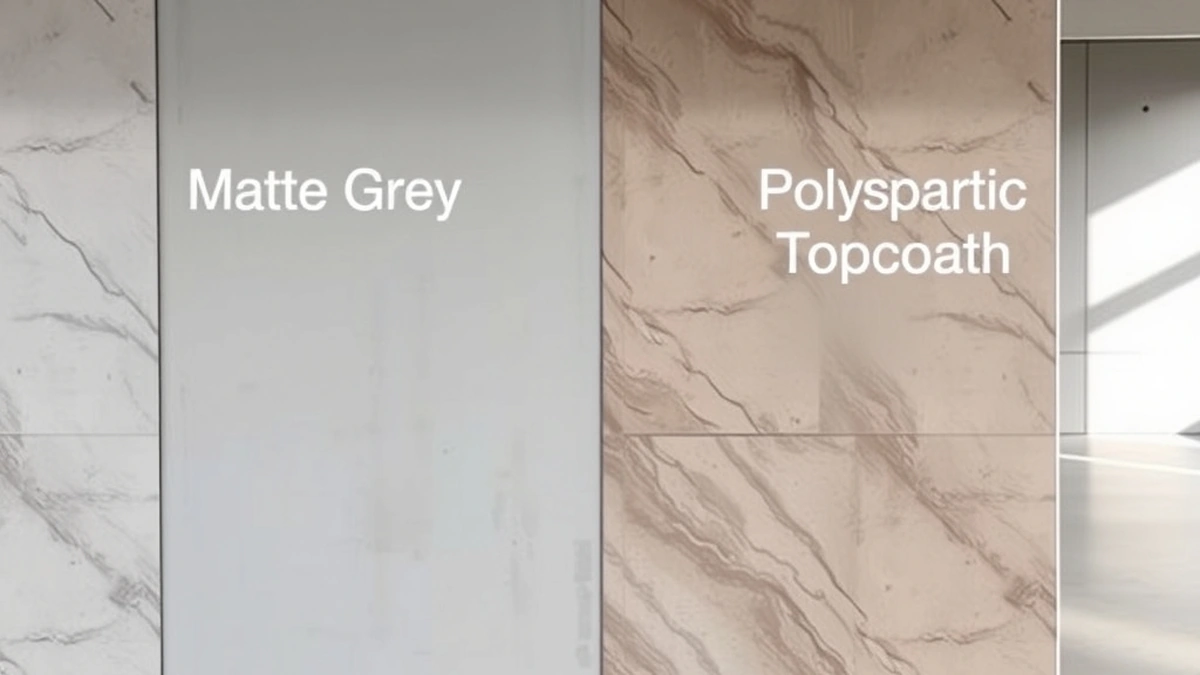
Polyaspartic vs epoxy: layer by layer
Polyaspartic vs epoxy is a question about layers, not rivals. Epoxy builds the base at $5-12 per sq ft; polyaspartic takes the wear at $8-15 as a system.
Polyaspartic vs epoxy is mostly a question of order: epoxy is the base coat at $5-12 per sq ft, polyaspartic is the aliphatic topcoat, and a full polyaspartic system runs $8-15 per sq ft. Epoxy builds film cheaply; polyaspartic handles UV and fast return to service.
- Professional epoxy
- $5-12 / sq ft
- Polyaspartic system
- $8-15 / sq ft
- Epoxy cure to traffic
- 3-7 days
- Polyaspartic to traffic
- About 24 hours
Some links on this page are affiliate links.If you buy through them we may earn a commission at no extra cost to you. We do not accept payment for rankings. Read the full disclosure.
Polyaspartic versus epoxy is less a contest than a question of which layer goes where. Epoxy is the build coat: cheaper per square foot, thicker per pass, and the layer that bonds to the concrete and carries the color. Polyaspartic is the wear coat: aliphatic, UV stable, fast curing and tougher against abrasion. Most durable residential garages use both, and the real decision is whether you need the topcoat.
What each one is
An epoxy coating is a two-part thermosetting resin in which an epoxide reacts with an amine hardener to form a rigid, chemically resistant film that bonds mechanically to a ground slab.
Polyaspartic is a two-component aliphatic polyurea built on aspartate esters. It cures by a different reaction, stays color-stable under ultraviolet light, and forms a more flexible film than a rigid epoxy.
Neither is a primer in the ordinary sense, neither is a paint, and neither one seals a slab. They are coatings that sit on top of concrete, which is why the preparation underneath decides how long either lasts.
Where each layer goes
| Layer | Product | Role |
|---|---|---|
| Primer | Epoxy, often solvent-based | Seals the surface and promotes adhesion |
| Base coat | 100% solids epoxy | Builds film, carries color, holds flake |
| Broadcast | Vinyl flake | Hides slab variation, adds texture |
| Topcoat | Polyaspartic | UV stability, abrasion resistance, fast cure |
Read the table as a sequence, not a menu. The epoxy layers do the structural work and the polyaspartic does the surface work, which is why “polyaspartic floor” in a quote usually means a system that contains epoxy.
Head to head on the six things that matter
| Attribute | Epoxy | Polyaspartic |
|---|---|---|
| Installed cost | $5-12 / sq ft | $8-15 / sq ft |
| Pot life at 70°F | 20-40 min | 10-20 min |
| Vehicle traffic | 3-7 days | About 24 hours |
| UV stability | Ambers under sun | Color stable |
| Abrasion | Good | Better |
| Skill required | Forgiving | Unforgiving |
The cost row and the skill row are related. A slow product forgives a mistake because you can roll it out again; a fast product sets while you are deciding. That is why the same crew can install an excellent epoxy floor and a mediocre polyaspartic one.
The cost difference, with the arithmetic
A professional epoxy system runs $5 to $12 per square foot. A polyaspartic system runs $8 to $15. The gap is $3 per square foot at both ends of the range.
- 400 sq ft epoxy: 400 × $5 = $2,000 to 400 × $12 = $4,800
- 400 sq ft polyaspartic: 400 × $8 = $3,200 to 400 × $15 = $6,000
- The difference: 400 × $3 = $1,200
Two other line items belong in the comparison because they apply to both: diamond grinding at $1 to $3 per square foot, which is $400 to $1,200 on 400 sq ft, and moisture mitigation at $2 to $5 per square foot, which is $800 to $2,000 if the slab fails a test.
Notice what those numbers imply. The cost of grinding plus mitigation, at the high end, is larger than the entire epoxy-versus-polyaspartic gap. Saving $1,200 on the topcoat and skipping $2,000 of mitigation is not a saving.
The all-polyaspartic build versus the hybrid
A full polyaspartic build skips the epoxy base and uses polyaspartic for every layer. It exists for commercial bays that cannot close for a week, and for cold-weather installs where an epoxy would not cure.
For a residential garage it is usually the wrong trade. You pay polyaspartic prices for film build that epoxy provides more cheaply, and you get a thinner floor for the same money. The hybrid — epoxy base, polyaspartic topcoat — lands inside the $8 to $15 band and delivers the properties people are actually buying.
The all-epoxy floor is the other legitimate single-product option. It is the right call for a rental, a workshop or a shaded garage where the ambering does not matter and the budget does.
Four steps to choose
- Check the sun. If direct light reaches the floor through the door or a window, plan on an aliphatic topcoat. Epoxy ambers under UV and no amount of topcoat quality fixes a base coat that has already shifted color.
- Count your downtime. Under three days without the garage, polyaspartic; a week or more available, epoxy will do.
- Test the slab before either. A moisture test decides whether you need mitigation at $2 to $5 per square foot, and that answer applies equally to both systems.
- Price the hybrid against the alternatives. Ask for an epoxy base with a polyaspartic topcoat, an all-epoxy system and an all-polyaspartic system on the same square footage, itemized the same way.
What neither one fixes
Both coatings are thin films measured in mils, and both obey the same physics. Neither fills a spalled area, bridges a moving crack, or survives moisture vapor pushing from below. Neither bonds to a slab with curing compound, sealer or oil on it.
That is why the specification that matters most in a garage is not the resin brand but the first two lines of the quote: grinding and testing. Everything after that is a choice between good options.
The layer-by-layer article on epoxy garage floor vs polyaspartic coating covers the same pair from the epoxy side, and yellowing cost prices the UV problem when only a topcoat is added later. For the dollars, polyaspartic cost itemizes the topcoat system and how long epoxy garage floor lasts sets the service-life expectation for the base. Flake broadcast vs epoxy explains the layer in the middle.
Frequently asked questions
Can you put polyaspartic over epoxy?
Yes, and it is the standard residential detail: grind, prime, an epoxy base coat with flake, then a polyaspartic topcoat. The epoxy has to be clean and either within its recoat window or abraded so the topcoat has something to grip.
Which is stronger, polyaspartic or epoxy?
They are strong in different ways. Epoxy builds a thicker, harder film per dollar and bonds well to prepared concrete; polyaspartic is more flexible, more UV stable and more abrasion resistant. A floor that uses both gets each property where it is needed.
Is polyaspartic worth $3 more per square foot?
On 400 sq ft the gap is 400 × $3 = $1,200. It pays when the floor faces the sun, when the garage cannot be out of service for a week, or when road salt is a daily reality. A shaded garage with flexible timing does not need it.
How long before I can park on each one?
Standard epoxy typically wants 3 to 7 days before vehicle traffic. Many polyaspartic products accept a car in about 24 hours. Slab temperature moves both numbers, so the data sheet is the authority.
Does polyaspartic hide a bad slab better than epoxy?
No. Both are thin films over concrete, and both telegraph cracks, dips and moisture. A flake broadcast hides some cosmetic variation, but neither chemistry compensates for a slab that was not ground or not tested.
Which one should I choose for a rental property?
Epoxy, usually. A rental garage rarely justifies the UV-stable premium, and a single-color epoxy at the low end of the $5-12 band gives a durable floor for the least money. Spend the savings on grinding and a proper moisture test.
Sources
Some links are affiliate links.If you buy through them we may earn a commission at no extra cost to you. We do not accept payment for rankings. Read the full disclosure.