Garage floor epoxy kit
What is really inside a garage floor epoxy kit, how coverage math works at 10 mils, and when a boxed kit is the wrong buy for your slab.
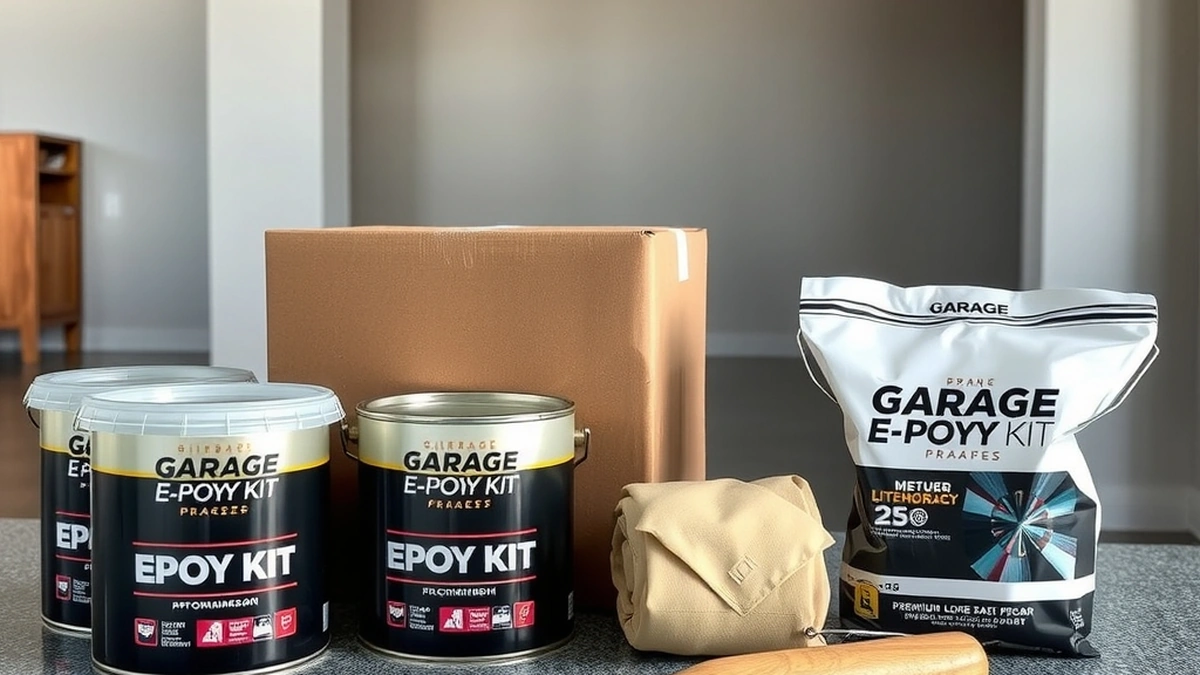
A garage floor epoxy kit is a boxed two-part resin system sized by coverage, usually for a one- or two-car slab. Kits run $3-7 per sq ft in materials. Check the coverage rate at your target film thickness before buying — most boxes assume a thin coat.
- Kit materials
- $3-7 / sq ft
- Professional epoxy
- $5-12 / sq ft
- Coverage at 10 mils
- ~160 sq ft / gal
- Diamond grinding
- $1-3 / sq ft
Some links on this page are affiliate links.If you buy through them we may earn a commission at no extra cost to you. We do not accept payment for rankings. Read the full disclosure.
A garage floor epoxy kit is a boxed two-part resin system — Part A resin, Part B hardener, and usually flake, a mixer and a roller — sized by the square footage it claims to cover. Materials run $3 to $7 per square foot. The one number to check before you buy is the coverage rate at your target film thickness, because most boxes are priced on a coat far thinner than a garage floor needs.
What is actually in the box
A garage floor epoxy kit is a packaged coating system that cures by a chemical reaction between resin and hardener, sold in a quantity matched to a typical garage size. The chemistry is the same as a professional product; the difference is what else is in the box.
Most kits include a gallon or two of resin, the matching hardener, a mixing paddle, a roller cover, a bag of vinyl flake and a printed instruction sheet. Fewer include a primer, a clear topcoat, crack filler, a moisture test or any surface prep beyond a citric acid etcher. Those missing items are the real scope of the job.
Coverage math the label does not do for you
Coverage is volume divided by film thickness. One US gallon spread at 1 mil covers about 1,604 square feet, so the same gallon at 10 mils covers roughly 160 square feet of 100% solids epoxy.
Run it for a 400 sq ft garage:
- 400 sq ft × 10 mils = 4,000 mil-square-feet of wet film.
- 4,000 ÷ 1,604 = 2.5 gallons of 100% solids material.
- A two-gallon kit applied at 10 mils covers 2 × 160 = 320 sq ft, not 400.
That is the trap. A “two-car garage kit” is often sized at 4 to 5 mils, which is a thin coat, and it looks correct on the box because the box uses the same square footage you do. Buy by gallons at your target thickness, and buy about 10% extra for waste, roller loss and touch-ups.
Solids content compounds the problem. A 60% solids product applied at 10 mils wet leaves 6 mils dry, so two gallons that would cover 320 sq ft at 10 mils dry in 100% solids covers only about 192 sq ft at the same dry thickness. The label rarely does that arithmetic for you.
What kits include, and what they leave out
| Component | Usually in the kit | Cost if bought separately |
|---|---|---|
| Resin and hardener | Yes | Part of the $3-7 per sq ft |
| Vinyl flake | Sometimes, light coverage | Small line item |
| Primer | Rarely | Adds a coat and a day |
| Clear topcoat | Sometimes | Adds $0.50-1.50 per sq ft |
| Crack filler | No | Small tub |
| Moisture test | No | A kit costs about as much as a gallon |
| Grinding | No | $1-3 per sq ft |
The last row is the one that decides the outcome. A kit assumes a clean, open, profiled slab. If your concrete is sealed, painted or smooth, the kit’s adhesion story starts with prep you have to supply, and grinding at $1 to $3 per square foot is not optional.
The real cost per square foot
At $3 to $7 per square foot in materials, a 400 sq ft floor costs $1,200 to $2,800 for the coating alone. Add grinding at $1-3, or $400 to $1,200, and the total is $1,600 to $4,000.
Compare that against a professional system at $5 to $12 per square foot, which is $2,000 to $4,800 on the same floor and includes labor, prep and usually a warranty. The gap at the low end is only $400. At the high end the DIY route saves $800 — for a weekend of work and no warranty. Scale the same arithmetic to 600 sq ft and the material cost is $1,800 to $4,200 against $3,000 to $7,200 installed. Run your own numbers before assuming the kit is the cheap option; epoxy garage floor cost per square foot has the full breakdown.
If the slab needs moisture mitigation at $2 to $5 per square foot, the arithmetic changes again: 400 × $2 = $800 minimum, and that product is not sold in a homeowner kit.
When a kit is the wrong purchase
The slab fails a moisture test. Vapor-barrier primers are professional products with narrow recoat windows.
The concrete is damaged. Spalling, settled sections and active cracks need repair before any coating.
The floor is large. Above roughly 600 sq ft, the mixing and rolling pace becomes the limiting factor, and a crew with a squeegee and an experienced back-roll will beat a homeowner with a kit on both speed and film control.
You want metallic. Metallic pours need color control, a clear topcoat and practice. A boxed kit is not the format.
In those cases the honest answer is a contractor, not a bigger box. DIY epoxy garage floor sets out exactly where the line falls.
Five checks before you pay for a kit
- Read the coverage rate and the film thickness it assumes. Multiply the gallons by 160 at 10 mils and compare against your square footage.
- Confirm it is two-part, 95-100% solids. One-part “epoxy paint” is a different product with a shorter life.
- Check what the box omits. Primer, topcoat, flake weight, crack filler and a moisture test all matter.
- Match the kit to your slab condition. Sealed or painted concrete means grinding, not etching.
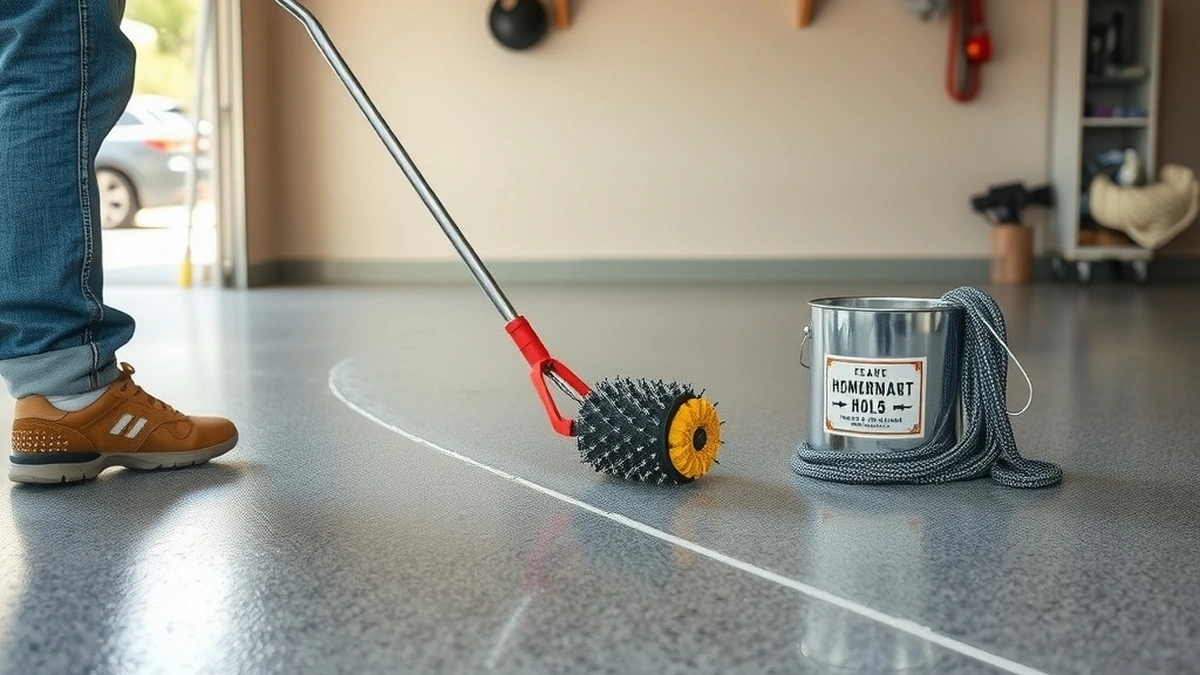
- Plan the extras. Spiked shoes, a second roller cover, a mixing paddle for a drill, a bucket grid and a wet-film gauge are cheap compared with a failed coat.
Once the materials are on site, the installation sequence matters more than the brand: grind, vacuum, prime, base, flake, scrape, topcoat, cure. Types of epoxy garage floor explains what the different formulations are for, best epoxy garage floor covers the spec numbers worth checking, and epoxy garage floor repair is the page to read if a previous kit has already lifted.
Frequently asked questions
How many kits do I need for a two-car garage?
Work it out from film thickness, not the box label. A 400 sq ft floor at 10 mils dry needs about 2.5 gallons of 100% solids epoxy, so a kit that yields 2 gallons at that thickness is short.
What is usually missing from a kit?
Grinding equipment, a moisture test, crack filler, spiked shoes, extra roller covers and sometimes the clear topcoat. Those omissions are why the material price looks lower than an installed quote.
Does a kit include the flake?
Some do and some do not. Check the weight of the flake included against the square footage, and buy extra if you want a full broadcast rather than a light sprinkle.
Can I add a second coat from the same kit?
Only if the kit has material left after the first coat. Coverage rates are quoted at a specific film thickness, and splitting one kit across two thin coats produces two weak coats rather than one thick one.
Are 1-part epoxy paints the same thing?
No. A one-part product is a paint, not a catalyzed resin, and it wears through at the tire path within a few years. A kit worth buying has two components that must be mixed at a stated ratio.
How long does an opened kit last?
Mix only what you can apply within the pot life, usually 20 to 40 minutes at 70°F. Resin and hardener keep for months sealed; a mixed batch is finished when it gels, and it cannot be revived.
Sources
Some links are affiliate links.If you buy through them we may earn a commission at no extra cost to you. We do not accept payment for rankings. Read the full disclosure.