Epoxy floor durability
Epoxy floor durability depends on adhesion, film thickness and topcoat, not on the brand. Here is what it resists, what it does not, and how to make it last.
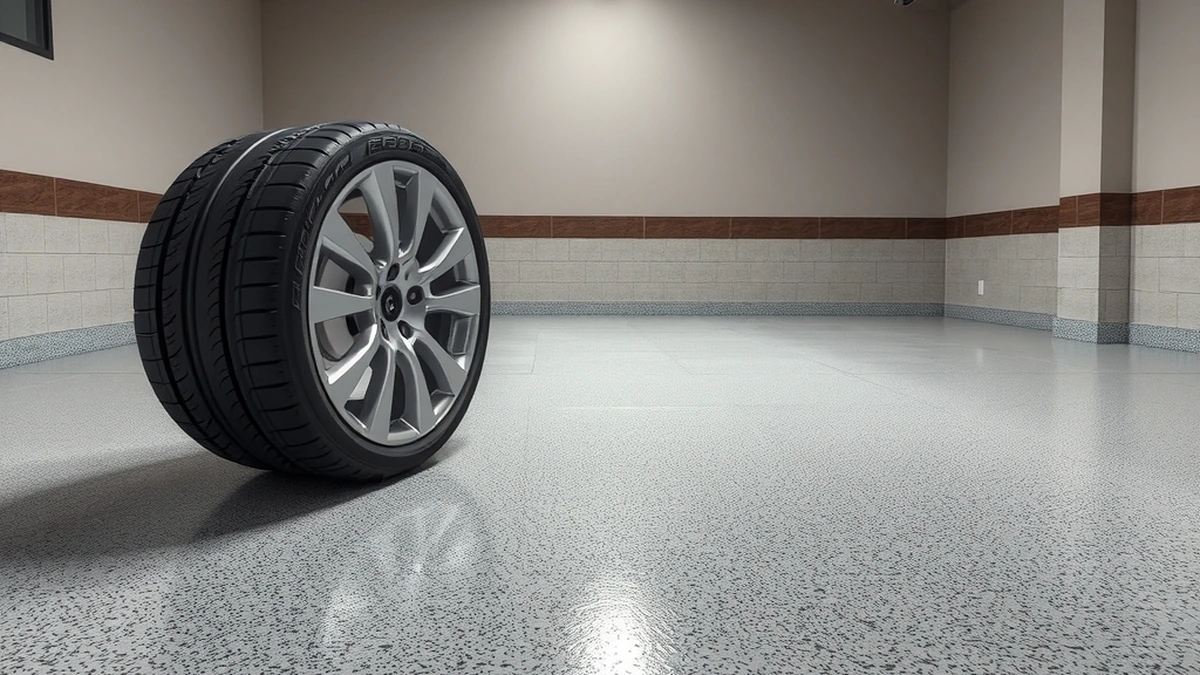
Epoxy floor durability comes from three things: a profiled slab, a film build of 8 to 20 mils, and a topcoat matched to the traffic. A proper system resists hot tires, road salt and dropped tools, but not UV, vapor or a slab that was never ground.
- Typical film build
- 8 - 20 mils total
- Cure before traffic
- 3 - 7 days epoxy
- Fast-return system
- 24 hours polyaspartic
- Weak point
- Adhesion to the slab
Some links on this page are affiliate links.If you buy through them we may earn a commission at no extra cost to you. We do not accept payment for rankings. Read the full disclosure.
Epoxy floor durability is set by three things you can inspect before the first coat goes down: how the slab was prepared, how thick the film is built, and what topcoat carries the traffic. Get those right and an epoxy floor handles hot tires, road salt, oil and dropped tools for years. Get them wrong and the best resin on the market fails in a season.
What durability actually measures
Epoxy floor durability is the ability of a cured resin system to keep its bond to concrete and its surface intact under abrasion, impact, chemicals, moisture and temperature change.
Five separate properties sit under that sentence, and a product can be strong on one and weak on another:
Adhesion is the bond to the slab. It is created by mechanical profile and by a clean, dry substrate. Nothing else compensates for a missing bond.
Abrasion resistance is the surface’s ability to resist grit and foot traffic wearing it away. Film thickness and topcoat chemistry drive it.
Impact resistance is the ability to absorb a dropped tool or a jack stand without cracking. A thicker, more flexible system performs better than a hard, thin one.
Chemical resistance is specific, not general. Brake fluid, battery acid, road salt and hot motor oil each attack different resin chemistry.
UV stability is the weak point of standard epoxy. Aromatic epoxy ambers in sunlight; a polyaspartic topcoat is what fixes it.
The numbers that set the service life
Durability is not an abstraction. It maps to a small set of measurable build decisions.
- Film thickness. A single epoxy coat is typically 8 to 12 mils; a full system with primer, base and topcoat builds 15 to 20 mils. Wear life scales roughly with the thickness of the wear layer.
- Grinding cost at $1 to $3 per square foot. On 400 sq ft that is $400 to $1,200, and it is the line that creates the profile the coating locks into.
- Coating cost at $5 to $12 per square foot installed. On 400 sq ft that is $2,000 to $4,800 for a system that includes a topcoat.
- Cure window of 3 to 7 days before vehicle traffic on a standard epoxy system, or about 24 hours with a polyaspartic topcoat.
- Moisture mitigation at $2 to $5 per square foot when a slab fails a vapor test, or $800 to $2,000 on 400 sq ft.
A $1,200 DIY kit at $3 per square foot on 400 sq ft is a thin system. A $4,800 professional install at $12 is a thick one with a premium topcoat. The durability difference between those two floors is larger than the price difference suggests.
What epoxy handles and what it does not
| Exposure | Performance | Notes |
|---|---|---|
| Hot tires | Good | Best with a polyaspartic or heavy topcoat |
| Road salt and brine | Good | Rinse in spring; salt sits in the texture |
| Motor oil and grease | Good | Wipe before it tracks |
| Brake fluid | Fair | Wipe immediately; it softens cured film |
| Battery acid | Fair | Neutralize and rinse |
| Sunlight | Poor | Ambers without a UV-stable topcoat |
| Standing water | Fair | Ponding and vapor pressure cause blistering |
| Welding spatter | Poor | Burns through the film |
| Dragged metal, jacks | Fair | Scuffs and gouges the clear coat |
The table matters more than any single adjective. A floor that sees welding and dragged engine hoists is a different specification from one that sees a parked SUV.
The three failures that are not the resin’s fault
Most durability complaints trace to the slab, not the coating.
Delamination shows as sheets lifting from the concrete, often with a chalky dust underneath. It is caused by a weak profile, a sealer left in place, or oil soaked into the pores. The fix is a full grind and a new system, which costs the original job twice.
Blistering shows as raised bumps, sometimes with water inside. It is vapor pressure from a slab passing moisture, and no coating survives it. Mitigation at $2 to $5 per square foot is the repair, and it has to happen before the coating.
Hot tire pickup is coating sticking to warm rubber and peeling away with the tire. On paint it is routine. On epoxy it usually means a thin film or a topcoat that was never applied.
None of these are visible on the day of installation. All three are visible in the estimate: whether grinding is listed, whether a moisture test is required, and whether a topcoat is a separate line.
Epoxy versus polyaspartic versus polyurethane
The three resin families are often compared on durability alone, and the comparison is not close on every axis.
Standard epoxy is the hardest and most chemically resistant of the three at a given film build, and the cheapest at $5 to $12 per square foot installed. It is also the most brittle and the least UV stable.
Polyaspartic at $8 to $15 per square foot cures fast, stays clear under UV and stays flexible, which makes it a better topcoat than a base coat. It costs more and has a shorter working time.
Polyurethane sits between them on cost and is typically used as a topcoat where chemical resistance and flexibility both matter.
The practical answer for a garage is a hybrid: epoxy base for build and adhesion, polyaspartic clear for the wear surface. That combination costs more than epoxy alone and less than a full polyaspartic system.
How to build a floor that lasts
- Test the slab for moisture. An in-situ relative humidity test, not a plastic sheet, before the budget is set.
- Grind, do not etch. Diamond grinding at $1 to $3 per square foot, with a dust shroud and a shop vacuum.
- Repair before coating. Route and fill working cracks, patch spalls, and let the patch cure fully.
- Prime the slab. A primer on porous or lightly profiled concrete keeps the base coat from starving.
- Build the film. Base coat, broadcast and a clear topcoat, each at the manufacturer’s spread rate rather than a thin “insurance” coat.
- Respect the cure. No vehicle traffic for 3 to 7 days on standard epoxy; foot traffic sooner.
- Recoat before failure. A clear-coat refresh at the first sign of wear in the traffic lane is far cheaper than a full replacement.
For the timeline behind those steps, how long does epoxy garage floor last puts service life in context. Epoxy garage floor topcoat explains which clear coat to specify, and epoxy maintenance covers what to do after the floor is in service.
If the floor is already failing, epoxy garage floor repair describes the patch process before you decide to recoat.
Frequently asked questions
How durable is epoxy flooring really?
A correctly installed epoxy system is hard, seamless and resistant to hot tires, road salt, oil and most household chemicals. Its durability is limited less by the resin than by the bond to the concrete underneath it.
What is the most common cause of epoxy failure?
Moisture and poor surface preparation. A slab that was acid-etched instead of ground, or one passing vapor, will delaminate or blister regardless of how good the coating is.
Does epoxy scratch easily?
It resists abrasion better than paint or vinyl tile but it is not scratch-proof. Grit under a car tire and dragged metal both mark it. A clear topcoat is the sacrificial layer that takes that wear.
How long does an epoxy garage floor last?
That depends on prep, film build, topcoat and traffic. A properly built residential system with a topcoat is commonly expected to give many years of service before a recoat, while a thin single-coat kit may fail within a few seasons.
Is epoxy slippery when wet?
A gloss epoxy floor is slippery with water on it. A slip-resistant additive in the topcoat, usually aluminum oxide or a polymer grit, adds traction at the cost of a slightly textured finish.
Can you make epoxy more durable?
Yes. Grind rather than etch, add a primer on porous slabs, build the film with a base coat plus a topcoat, and specify a polyaspartic clear where UV or fast return to service matters.
Sources
Some links are affiliate links.If you buy through them we may earn a commission at no extra cost to you. We do not accept payment for rankings. Read the full disclosure.