Flake broadcast maintenance
How to clean, protect and recoat a flake broadcast floor, with a realistic schedule and the products that damage the topcoat.
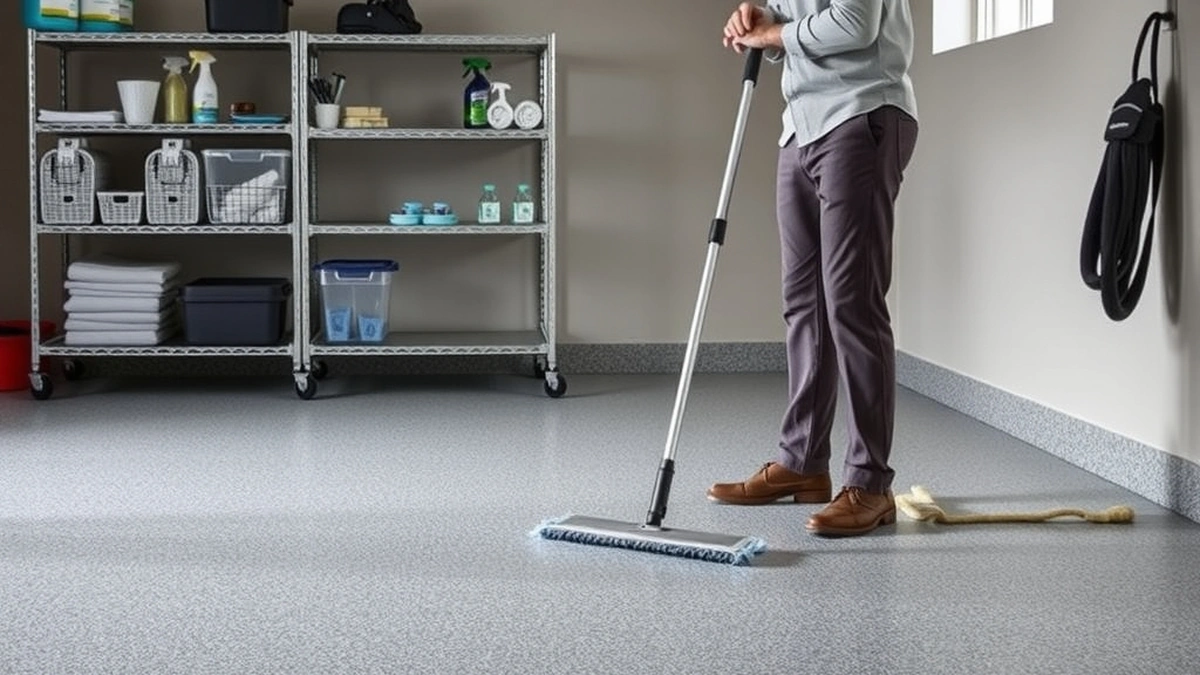
Flake broadcast maintenance is mostly the topcoat: sweep or dust-mop weekly, clean spills with a pH-neutral cleaner, avoid citrus and acetone, and plan a recoat in the tire paths every 8 to 12 years. The flake layer itself rarely needs attention.
- Routine cleaning
- Weekly sweep, damp mop monthly
- Cleaner pH
- Neutral, 7 to 9
- Recoat window
- 8 - 12 years in tire paths
- Avoid
- Citrus solvents, acetone, harsh degreasers
Some links on this page are affiliate links.If you buy through them we may earn a commission at no extra cost to you. We do not accept payment for rankings. Read the full disclosure.
Flake broadcast maintenance is really topcoat maintenance. The vinyl chips are embedded and stable; the clear layer above them takes the abrasion, the sunlight, and the chemicals, and it is the layer that determines how long the floor looks new. A weekly sweep, a monthly neutral mop, and a recoat in the tire paths every 8 to 12 years cover almost everything.
What is actually wearing
A flake broadcast floor is a sandwich: epoxy base, vinyl flake, clear topcoat. The flake is decorative and slightly porous if exposed. Once the topcoat wears through in a traffic lane, the flake begins to pick up dirt and the base color starts to show through.
That is why maintenance should be aimed at the topcoat rather than the pattern. Keeping the film intact is cheaper than repairing exposed flake, which requires cleaning out the worn area and rebuilding it with base, flake, and clear.
A realistic maintenance schedule
| Task | Frequency | Product |
|---|---|---|
| Sweep or dust mop | Weekly | Soft-bristle or microfiber |
| Damp mop | Monthly | pH-neutral floor cleaner |
| Spot clean spills | Immediately | Water, then neutral cleaner |
| Inspect tire paths | Twice a year | Eyes and a dry cloth |
| Clean garage door threshold | Twice a year | Neutral cleaner, rinse |
| Recoat worn lanes | 8 - 12 years | Compatible topcoat |
The threshold and the first 3 feet inside the door take the most grit and the most UV. They are also the first places a topcoat dulls, so they are worth checking when the rest of the floor still looks fine.
Cleaning without damaging the film
Sweep first. Grit under a mop acts like sandpaper on a 3 mil film, and a floor that is mopped without sweeping dulls faster than one that is swept twice a week.
Use a pH-neutral cleaner diluted per the label. Alkaline degreasers strip the topcoat’s gloss and, repeated over years, soften the film. Acidic cleaners etch it. Citrus-based solvents and acetone are worse: they attack polyurethane and polyaspartic directly and can leave a sticky, dull patch that never recovers.
For oil spots, blot with an absorbent pad, then clean with a small amount of neutral cleaner and rinse. For rust, a diluted oxalic acid cleaner followed by a thorough rinse is the usual approach, but test it on an out-of-sight area first because it can dull the gloss.
What not to do
Pressure washing at close range is the most common self-inflicted damage. Water forced under an edge lifts the coating, and once water is behind the film, the bond is gone. A low-pressure washer with a wide fan nozzle, kept moving, is acceptable on a sound floor.
Dragging metal objects — a floor jack, a welding table, a snow shovel — scratches the topcoat. Felt pads or plastic runners under heavy items prevent most of it. Welding spatter burns through any coating and should be caught with a welding blanket, not cleaned up afterward.
Ice melt is a seasonal issue. Calcium chloride and rock salt sit on the floor in winter and hold moisture against the film. A mat inside the garage door and a rinse in spring limit the exposure.
When a recoat is the right call
A recoat is due when the topcoat has worn thin in the tire paths, when the gloss has gone flat across a large area, or when the flake starts to look dirty even after cleaning. Small wear spots can be spot-coated.
The arithmetic is straightforward. A professional recoat typically prices below a full system because the base and flake are sound; using the coating range of $5 to $12 per square foot, a 400 square foot recoat at $6 is 400 × $6 = $2,400, and at $9 it is $3,600. A spot repair kit for two tire lanes costs a fraction of that, so inspect before assuming the whole floor needs work.
Compare that with a full replacement, which requires grinding off the existing system at $1 to $3 per square foot plus a new base and topcoat. On the same 400 square feet, grinding at $2 alone is $800 before any new material.
The five-step deep clean
- Remove everything from the floor and sweep or vacuum the full area.
- Mix a pH-neutral cleaner at the label dilution in a bucket of warm water.
- Mop in 10 by 10 foot sections, changing water when it turns grey.
- Rinse with clean water and a fresh mop head, then squeegee or wet-vac the excess.
- Let the floor dry completely before moving equipment back in, usually 2 to 4 hours.
Do this once a year, and the monthly damp mop becomes a quick pass rather than a scrubbing job.
Maintenance costs over a decade
Assume a 400 square foot floor, a $30 bottle of neutral cleaner every four months, and a mop head every year. That is roughly $90 per year in consumables, or $900 over ten years. Add one spot recoat at year six, using a small kit that covers 100 square feet at the DIY rate of $5 per square foot, or $500.
The ten-year maintenance total is about $1,400, against a replacement cost of several thousand dollars. That ratio is the argument for the weekly sweep: the cheapest maintenance item prevents the most expensive repair.
For the install sequence that determines how well the topcoat bonds in the first place, see the flake broadcast installation guide. If the floor is already showing worn lanes and dull patches, the repair guide explains how to assess whether a spot coat will hold. And before committing to a recoat quote, check current installation pricing so the recoat is priced against a realistic baseline.
Frequently asked questions
How often should I mop a flake epoxy floor?
Damp mop monthly with a pH-neutral cleaner and spot clean spills as they happen. Weekly sweeping or dust mopping removes the grit that dulls the topcoat.
Can I use a pressure washer on a flake floor?
A low-pressure washer is acceptable on a sound topcoat, but keep the nozzle moving and never hold it close to an edge or a crack where water can get under the film.
Will hot tires damage the flake floor?
A quality polyaspartic or polyurethane topcoat resists hot tire pickup. A standard epoxy clear is more vulnerable, especially in the first month after installation.
How do I fix a worn spot in the tire path?
Clean and scuff the area, apply a compatible topcoat in two thin passes, and keep traffic off for 24 hours. Small wear spots do not require a full floor recoat.
Do I need to wax or polish the floor?
No. Waxes and polishes build a film that traps dirt and can yellow. A neutral cleaner and water are the correct maintenance products.
What causes white chalky marks on the floor?
Usually efflorescence or cleaner residue. Rinse with clean water and check that the slab is not wicking moisture through a failed edge or crack.
Sources
Some links are affiliate links.If you buy through them we may earn a commission at no extra cost to you. We do not accept payment for rankings. Read the full disclosure.