Flake broadcast reviews
How to read flake broadcast reviews without being misled: the themes that repeat, the questions reviewers never answer, and what to verify yourself.
Flake broadcast reviews are most useful for judging the installer, not the product. Read for prep details, moisture testing, and how failures were handled; treat star ratings without those details as noise, since the same kit performs well or badly based on surface preparation.
- Most useful signal
- Prep and moisture details in the review
- Least useful signal
- Star rating with no scope
- Typical install range
- $5 - $12 per square foot
- Grinding line item
- $1 - $3 per square foot
Some links on this page are affiliate links.If you buy through them we may earn a commission at no extra cost to you. We do not accept payment for rankings. Read the full disclosure.
Flake broadcast reviews tell you far more about the installer than about the flake. The chips are a commodity; the outcome depends on grinding, moisture testing, and the topcoat, and a review that does not mention those three things is closer to a comment about color than a report on durability. Read for process details, not stars.
What a review can and cannot tell you
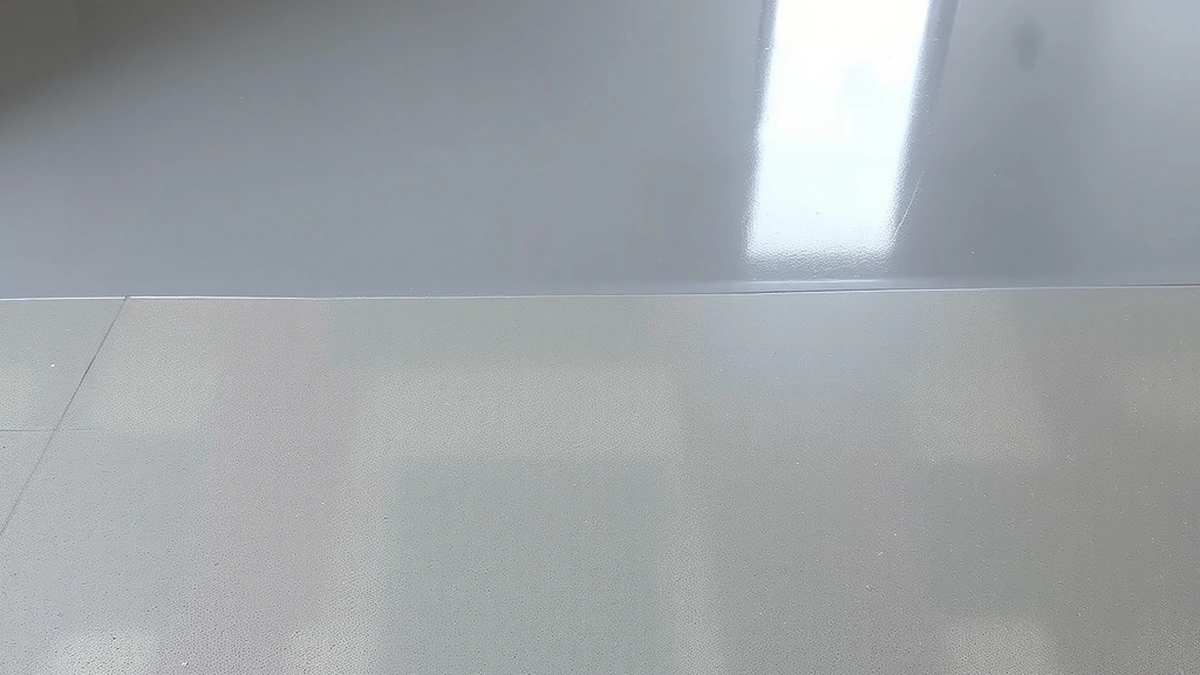
A flake broadcast floor is a system: epoxy base, vinyl flake, clear topcoat, all bonded to a prepared slab. A review written the day after installation can describe the pattern and the crew’s manners. It cannot describe adhesion, because adhesion fails months later.
That is the central limitation. Reviews are strongest on scheduling, cleanliness, communication, and the visual result. They are weakest on the two things that determine service life: how much surface was ground, and whether the slab’s moisture was measured before coating.
The themes that repeat
| Theme in reviews | What it usually means | What to ask |
|---|---|---|
| “Peeling at the edges” | Edges were not ground | How are stem walls and corners prepped? |
| “Bubbles after a month” | Moisture vapor through the slab | Was a moisture test done, and what was the result? |
| “Hot tire marks” | Weak or thin topcoat | Which topcoat chemistry, and at what film thickness? |
| “Color looks patchy” | Thin broadcast or late broadcast | Is the flake applied at full refusal? |
| “Great floor, two years on” | Prep and topcoat were done right | What did the scope include? |
Those five cover most of what buyers report, and none of them is about the flake brand. They are about the process.
Why the same product gets five stars and one star
Two homeowners can buy identical kits and get opposite results. The difference is almost always the slab. A clean, dry, uncoated slab that is ground to an open profile gives the epoxy a mechanical key. A slab with curing compound, carpet adhesive, or a high moisture vapor emission rate gives the same epoxy a smooth, contaminated surface with water pushing from below.
Cost explains part of the divergence. A professional install at $5 to $12 per square foot includes grinding at $1 to $3 and, where needed, moisture mitigation at $2 to $5. A DIY kit at $3 to $7 per square foot does not include either unless the buyer rents a grinder and tests the slab.
That is why a one-star review saying “peeled in six months” and a five-star review saying “still perfect after five years” can both be accurate and both be about the same product.
Reading a contractor review properly
- Look for the scope: square footage, grinding, crack repair, moisture testing, topcoat.
- Check the date relative to the install; a review at 30 days says nothing about durability.
- Look for photos taken at least a year later, ideally in the tire paths.
- Read the negative reviews first and note whether the complaint is prep, moisture, or topcoat.
- Check how the contractor responded, since warranty behavior matters more than a perfect record.
- Search the same reviewer’s other posts for consistency; a single angry review after a scheduling dispute reads differently from a pattern.
A review that says “great crew, cleaned up, floor looks amazing” is a review of the crew. A review that says “they ground the whole slab, tested moisture in three spots, and came back to fix a bubble at no charge” is a review of the process.
Red flags worth taking seriously
Repeated mentions of peeling at garage door thresholds point to edge preparation being skipped. Several reviews describing a white, chalky bloom point to moisture or efflorescence, which means the slab should have been tested before coating. Complaints about a soft or sticky floor after a month suggest an improperly mixed or expired product.
Vague praise is not a red flag on its own, but a five-star review with no detail and an account created the same week is worth discounting. So is a review that complains about price after the fact when the scope was clearly stated.
What to verify yourself instead of reading
The homeowner can check more than any review will tell them. Press a plastic sheet to the slab for 24 hours and look for condensation. Look for white powder or dark damp patches near the walls. Drag a chain across the floor: a hollow, drummy sound over a patch suggests a delaminated area or a hollow spot in the slab.
Then ask for the moisture result in writing. A contractor who has measured it will have a number. One who has not will change the subject.
A simple test of your own is to look at the floor after a heavy rain. Water that beads on the surface and evaporates is normal. Water that darkens the slab and stays dark for days indicates the concrete is holding moisture, which is exactly the condition that blisters a new coating. Note those areas and raise them before signing anything.
Putting reviews in perspective
Use reviews to build a shortlist of three contractors, then use scope documents to choose between them. The price range is broad — $5 to $12 per square foot for the coating alone — and the low end is only low because something is missing. Reviews help you find candidates; only the scope tells you what you are buying.
For the line items that should appear in every quote, read the flake broadcast cost breakdown. For what a correct install looks like step by step, see the installation guide. And if a review has you worried about an existing floor, the flake maintenance guide explains what can be recoated and what has to come off.
Frequently asked questions
Are flake broadcast floors worth the money?
For a garage that sees vehicles and occasional spills, yes. The floor hides dust, resists hot tires with a good topcoat, and costs less than a full tile or polished concrete job.
Why do reviews for the same kit disagree so much?
Because the kit is only part of the job. Two installers using the same product on slabs prepared differently will get a floor that lasts ten years and one that peels in eighteen months.
What should I look for in a contractor review?
Details about grinding, moisture testing, crack repair and the topcoat chemistry. A review that names those steps is worth more than twenty that only mention the color.
Do negative reviews usually mean a bad product?
Not usually. Most complaints describe peeling, blistering or hot tire pickup, and all three trace back to preparation, moisture, or an inadequate topcoat rather than the flake itself.
How many quotes should I get?
Three, with the same scope in writing. Comparing a quote that includes grinding against one that does not is not a price comparison, it is a scope comparison.
Can I trust photos in reviews?
Only if they show the floor a year or more after installation. A photo taken on install day shows the flake pattern, not how the coating performs.
Sources
Some links are affiliate links.If you buy through them we may earn a commission at no extra cost to you. We do not accept payment for rankings. Read the full disclosure.