Hot tire pickup: how to prevent it
How to prevent hot tire pickup before the coating goes down: topcoat chemistry, full cure, moisture control and the driving habits that lift a film.
Hot tire pickup is prevented by specifying an aliphatic polyurethane or polyaspartic topcoat, letting it cure 48 to 72 hours before parking, grinding the slab, and controlling moisture. Most cases trace back to a soft standard epoxy clear and a car parked too soon.
- Best topcoat
- Aliphatic polyurethane or polyaspartic
- Vehicle traffic
- 48 - 72 hours after topcoat
- Grinding
- $1 - $3 per square foot
- Moisture mitigation
- $2 - $5 per square foot
Some links on this page are affiliate links.If you buy through them we may earn a commission at no extra cost to you. We do not accept payment for rankings. Read the full disclosure.
Hot tire pickup is preventable at four points: the topcoat you specify, the cure time you allow, the preparation under the film, and the moisture in the slab. Get those four right and the floor will survive years of hot tires; get any one wrong and a tread-shaped patch will lift, usually in the first summer.
The mechanism, in one paragraph
A tire that has run at highway speed holds heat. When the car stops, that heat transfers into the coating. A standard epoxy clear softens at a lower temperature than an aliphatic polyurethane, and once it softens, the rubber in the tread bonds to the film more strongly than the film bonds to the layer below. When the car pulls away, the film goes with it.
Prevention is therefore about keeping the surface hard and the bond strong. Heat resistance comes from the topcoat chemistry; bond strength comes from grinding and moisture control.
Specify the right topcoat
The single most effective decision is the clear coat. An aliphatic polyurethane or polyaspartic topcoat at 3 to 6 mils resists heat and UV far better than a standard epoxy clear.
That specification sits at the top of the professional range. Epoxy systems run $5 to $12 per square foot installed; the urethane topcoat is part of that system price at the upper end. A quote that names “epoxy clear” as the finish is the quote most likely to produce tire marks.
Ask for the product data sheet and look for the words aliphatic polyurethane or polyaspartic. If the sheet says epoxy, the floor will be harder and more brittle, and more heat-sensitive.
Let it cure before parking
Cure time is the second lever, and it is the one homeowners most often ignore because the floor looks dry. A polyurethane topcoat that is dry to the touch has not fully cross-linked. Full chemical resistance develops over days, not hours.
At 70°F, allow 24 hours before foot traffic and 48 to 72 hours before vehicle traffic. At 60°F, add another day. At 50°F, the reaction slows dramatically and the floor may need a week.
Parking a hot car on a floor that is 36 hours old is how a perfect installation produces tire marks anyway. The marks are not a product defect in that case; they are a cure-time mistake.
Specification at a glance
| Decision | Weak choice | Strong choice |
|---|---|---|
| Clear coat | Standard epoxy clear | Aliphatic polyurethane or polyaspartic |
| Film thickness | One heavy pass, 8 mils | Two passes, 3 - 6 mils total |
| Cure before parking | 24 hours | 48 - 72 hours at 70°F |
| Slab preparation | Acid etch | Diamond grind at $1 - $3 per sq ft |
| Moisture | No test | Test, then mitigate at $2 - $5 per sq ft |
Preparation is the other half
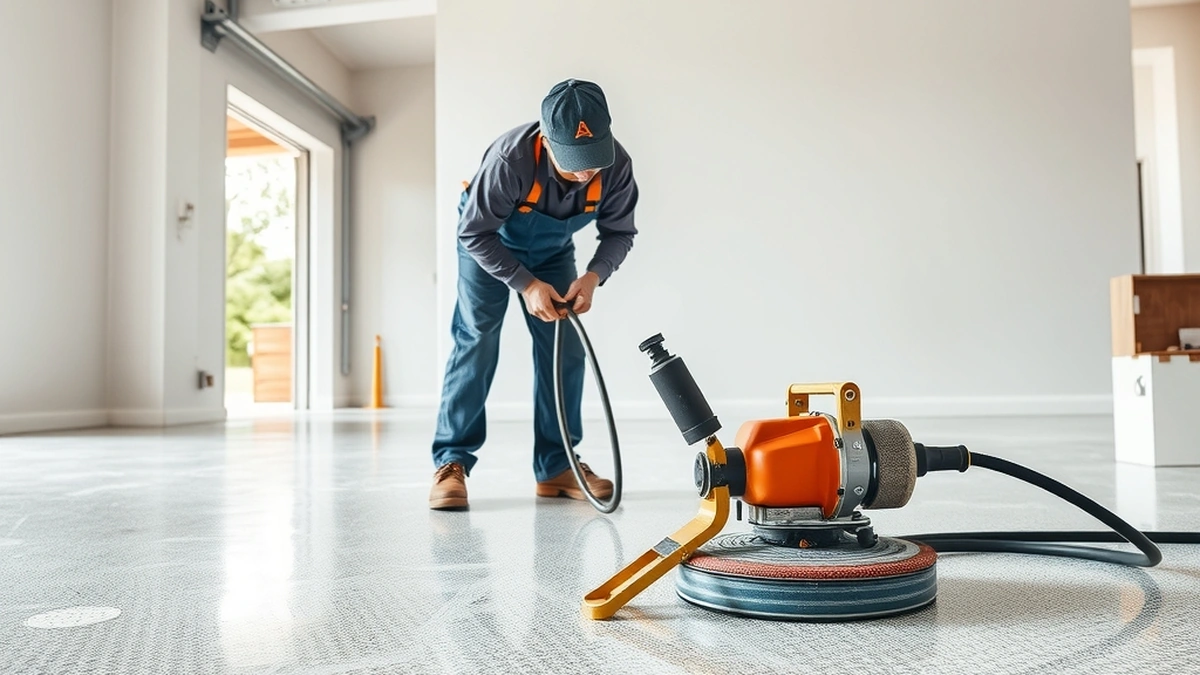
A topcoat can only hold if the base holds. Grinding at $1 to $3 per square foot opens the concrete profile and removes cure agents, sealers, and old coatings. A floor that was acid-etched instead of ground often has a weaker bond, and the failure shows up first where the tires sit.
Edge work matters too. The perimeter of the slab, where a large grinder cannot reach, is often the first place a coating lifts. A hand grinder and a careful vacuum pass along the stem walls prevent it.
Moisture control
Moisture vapor pushing up through a slab weakens the bond from below. When the tire heat arrives, the film lifts more easily because it was already partly detached.
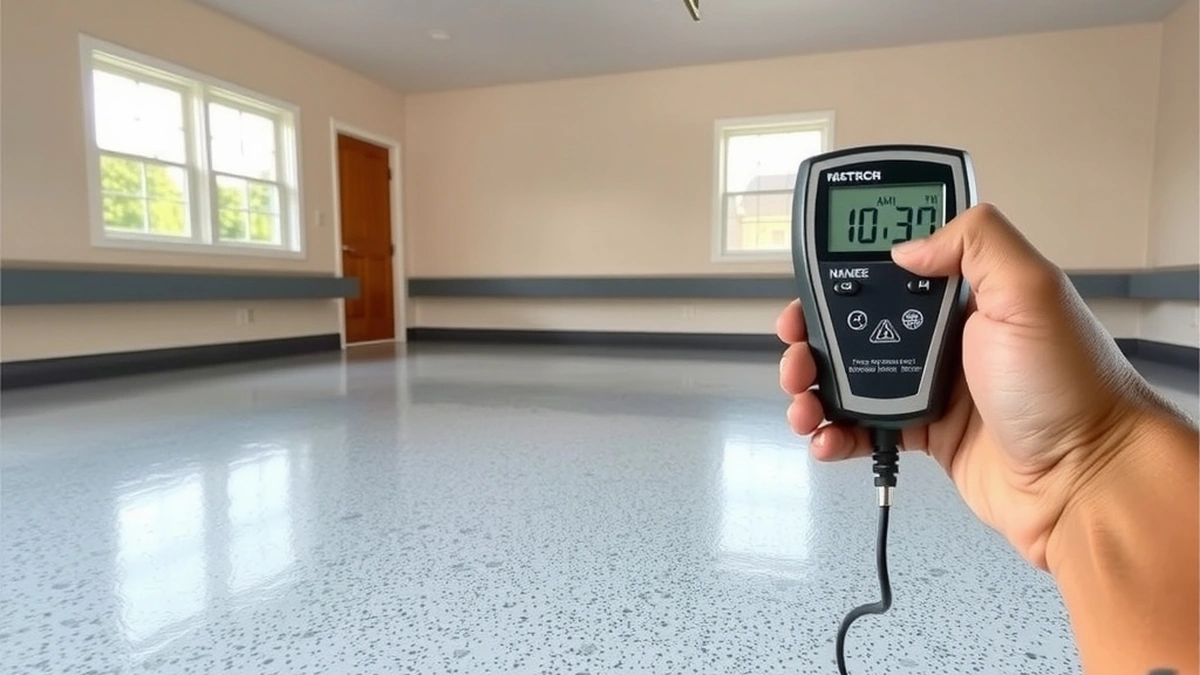
Test the slab before coating. A calcium chloride test or an in-situ relative humidity probe gives a number; a plastic sheet taped down for 24 hours gives a field indication. Where the reading is high, mitigation at $2 to $5 per square foot is the fix, and it is cheaper than a repair.
Habits that extend the life
- Wait the full cure time before parking, even if the floor looks ready.
- Park on mats for the first month if the garage runs hot.
- Avoid turning the steering wheel while the car is stationary; scrubbing a tire generates heat and shear.
- Keep the garage ventilated in summer so surface temperatures stay lower.
- Rinse winter salt off the floor in spring before it sits through a warm week.
- Inspect the tire lanes twice a year for dull patches that signal topcoat wear.
None of these replaces a correct specification, but together they reduce the heat and the contact time that cause the failure. A garage that faces west and bakes in the afternoon is the hardest case, and that is where the mats and the ventilation earn their keep.
What prevention costs against repair
A 400 square foot floor at $8 per square foot is $3,200, plus grinding at $2, or $800, for $4,000. Specifying a urethane topcoat instead of a standard epoxy clear may add a few hundred dollars within the system price.
A repair is $2,000 to $4,800 for a full recoat on the same floor, or $2,800 to $6,000 to grind and rebuild. Spending a few hundred at the specification stage avoids a multi-thousand-dollar redo.
If the floor is already showing marks, the repair options guide explains how to tell a cosmetic mark from a bond failure, and the cost breakdown shows the arithmetic for each path. For the selection decision behind the topcoat, see polyurethane vs epoxy.
Frequently asked questions
What topcoat prevents hot tire pickup?
An aliphatic polyurethane or polyaspartic clear coat. Standard epoxy clears are harder and more heat-sensitive, and they are the topcoat most often involved in tire pickup.
How long before I can park a car on a new floor?
48 to 72 hours at 70°F for a polyurethane topcoat. Cooler temperatures extend the cure, and parking early is the single most common cause of tire marks.
Does the base coat matter for tire pickup?
Yes. If the base is not bonded because the slab was not ground or was damp, the topcoat lifts with the base underneath it.
Will mats under the tires help?
They help on a floor that is still curing or in a garage that gets very hot. A mat spreads the load and keeps the tire off the film, but it does not fix a soft coating.
Can I add a grit additive to the topcoat?
Yes, and it slightly reduces the contact area between tire and film. It also dulls the gloss, so decide before the coat goes down.
Does hot weather make it worse?
Yes. A garage that reaches 100°F on a summer afternoon softens the film more than a shaded one, and a tire that is already hot adds to it.
Sources
Some links are affiliate links.If you buy through them we may earn a commission at no extra cost to you. We do not accept payment for rankings. Read the full disclosure.