Polyurethane vs Metallic pigment
A urethane clear over a metallic epoxy pour: how the topcoat affects depth, gloss and UV, and what the combination costs per square foot.
Metallic pigment forms the pattern in an epoxy pour; polyurethane is the clear coat that protects it. A metallic floor with an aliphatic urethane topcoat costs $10 to $20 per square foot, and the urethane is what keeps the pattern from yellowing and dulling.
- Metallic system
- $10 - $20 per square foot
- Urethane topcoat
- Upper part of the range
- UV stability
- Aliphatic urethane
- Gloss effect
- Deepens the pattern
Some links on this page are affiliate links.If you buy through them we may earn a commission at no extra cost to you. We do not accept payment for rankings. Read the full disclosure.
Metallic pigment and polyurethane are parts of one system rather than competing products. The pigment creates the pattern in a self-leveling epoxy pour; the polyurethane is the clear coat that protects it, adds gloss and blocks the UV that would otherwise amber the base. A metallic floor with an aliphatic urethane topcoat costs $10 to $20 per square foot.
The division of labor
A metallic floor is a decorative epoxy base. Pigment is blended into the resin, poured onto a prepared slab and worked to create movement, and the pattern is fixed when the epoxy cures.
Polyurethane is a clear film applied over that base. It provides abrasion resistance, chemical resistance and UV stability, and its gloss level determines how much light the metallic layer reflects.
Neither works alone in a garage. Pigment without a topcoat would wear away in the traffic lanes; a clear coat without a base would have nothing to protect. On a metallic floor the topcoat is doing double duty: it is the wear layer and the optical layer that keeps the pattern readable.
How the topcoat changes the result
| Topcoat | Effect on the pattern | Durability |
|---|---|---|
| Standard epoxy clear | Deep gloss, ambers with UV | Moderate |
| Aliphatic polyurethane | Deep gloss, stays clear | High |
| Polyaspartic | Deep gloss, fast cure | High |
| Satin urethane | Softer reflection | High |
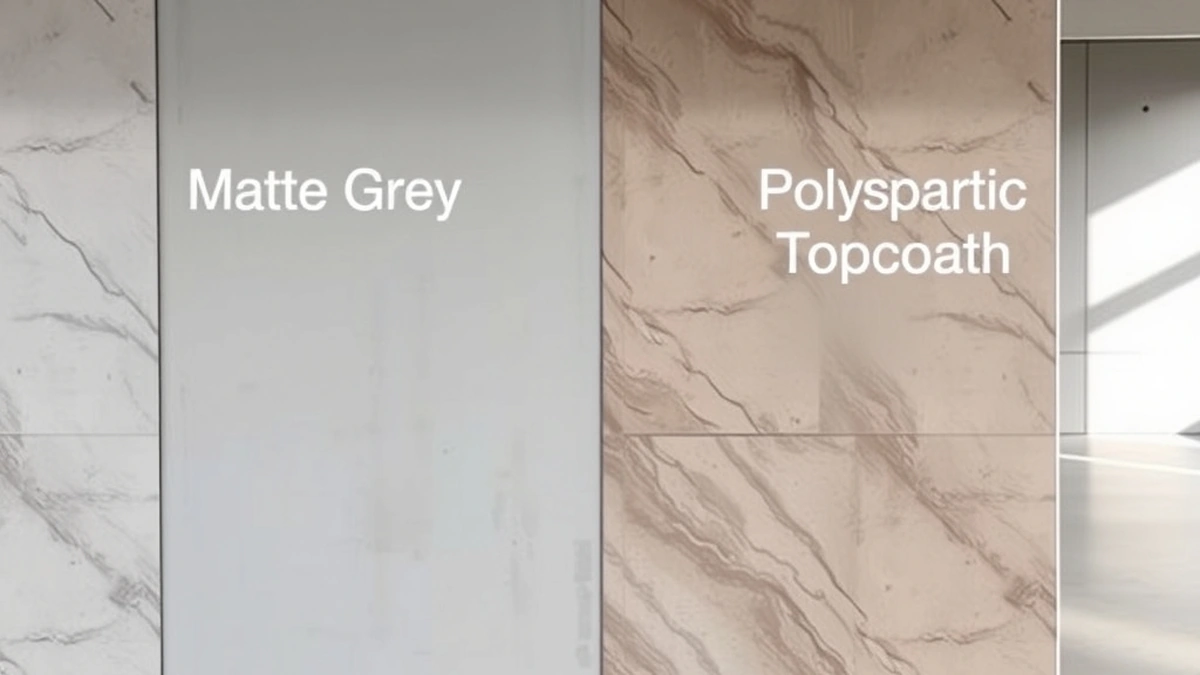
| Matte urethane | Flattens the depth | High |
The chemistry matters less than the grade. An aliphatic urethane and an aliphatic polyaspartic both protect the pattern well; a standard epoxy clear will amber and take the depth with it.
The arithmetic on 400 square feet
A metallic base at $15 per square foot is 400 × $15 = $6,000. Grinding at $2 adds 400 × $2 = $800, for $6,800.
The urethane topcoat is usually included in the system price. If it is quoted separately at $4 per square foot, 400 × $4 = $1,600, but most metallic quotes fold it in because the system is sold complete.
At the top of the range, $20 per square foot, 400 × $20 = $8,000 plus $800 grinding, or $8,800.
A standard epoxy floor at $8 per square foot is $3,200 plus $800, or $4,000. The metallic finish roughly doubles the cost for the same area.
Why the topcoat is not the place to save
On a solid-color floor, a cheap clear coat dulls the color. On a metallic floor, it destroys the effect. The pattern depends on light reflecting through a clear film, and a film that has yellowed or scratched scatters that light.
That is why a metallic quote that specifies a standard epoxy clear is a false economy. The premium for the metallic base has already been paid, and the topcoat is the layer that preserves it.
An aliphatic urethane also resists the hot tire pickup that would lift the film and leave a dull patch in the most visible part of the floor. On a metallic floor, that patch is impossible to blend, which is why the topcoat specification matters more here than on a flake floor.
Gloss, satin, and matte
Gloss is the default because it maximizes depth. A high-gloss urethane makes the metallic layer look like liquid metal, and it reflects the garage lighting in a way that hides the slab. It also shows every tire mark, so the trade is real.
Satin reduces the reflection and softens the pattern. It shows fewer scratches and tire marks than gloss, which makes it a practical choice for a working garage that still wants a metallic look.
Matte flattens the depth almost entirely. It is a design choice for a modern, low-sheen space, but it gives up the main reason to pay for metallic.
Maintenance of the combination
Clean with a pH-neutral product and a microfiber mop, sweep before mopping, and keep grit off the surface. A gloss metallic floor shows scratches and water spots more than any other finish.
Avoid citrus solvents, acetone and abrasive pads. They attack the urethane and leave a dull patch that cannot be polished back.
A recoat with urethane restores the gloss without repouring the metallic layer, which is the cheapest way to keep the floor looking new after 8 to 12 years.
Where the combination makes sense
A showroom, a home gym, a detailing bay or a garage that doubles as living space is the right setting. The floor is part of the design and the reflection is the point. Those are also the spaces where the extra $2,800 on a 400 square foot floor reads as a design budget rather than a maintenance liability.
A working garage with daily drivers and road salt is the wrong setting. The gloss shows every mark, and the maintenance to keep it looking right is more than most owners want. A flake floor at $5 to $12 per square foot is the practical answer for that garage.
How to specify it
- Confirm the base is a self-leveling metallic epoxy, not a thin roll coat.
- Specify an aliphatic polyurethane or polyaspartic topcoat.
- Choose the gloss level before the pour, not after.
- Confirm grinding and moisture testing are included.
- Ask how the topcoat will be applied to avoid laps.
- Confirm the cure time before vehicles return.
For the cost detail, see the metallic pigment cost breakdown. For the defects to watch for, read metallic pigment problems, and for the topcoat comparison, check polyurethane vs epoxy.
Frequently asked questions
Can polyurethane go over metallic epoxy?
Yes. The metallic base cures, is lightly sanded, and the urethane clear is applied as the wear layer. It is the standard topcoat for a metallic floor in a sunlit garage.
Does urethane change how the metallic pattern looks?
It changes the gloss, which changes how the pattern reads. A high-gloss urethane deepens the reflection; a satin finish flattens it.
Will urethane stop the metallic floor from yellowing?
An aliphatic urethane resists UV ambering far better than a standard epoxy clear. It slows the change but no clear coat is permanent.
How much does the combination cost?
Metallic systems run $10 to $20 per square foot installed, with the urethane topcoat in the upper part of that range. Grinding at $1 to $3 is additional.
Is urethane better than polyaspartic over metallic?
Both work. Polyaspartic cures faster and is more heat resistant; urethane is more flexible and has a longer working window. Either must be aliphatic.
Can I recoat a metallic floor with urethane only?
Yes. Clean and scuff the existing topcoat, then apply the urethane clear. The metallic base stays in place and the gloss is renewed.
Sources
Some links are affiliate links.If you buy through them we may earn a commission at no extra cost to you. We do not accept payment for rankings. Read the full disclosure.