Garage floor paint vs epoxy
Garage floor paint costs about $0.15-$0.30 per sq ft in material; epoxy costs $3-$7 as a kit or $5-$12 installed. The difference is chemistry and thickness.
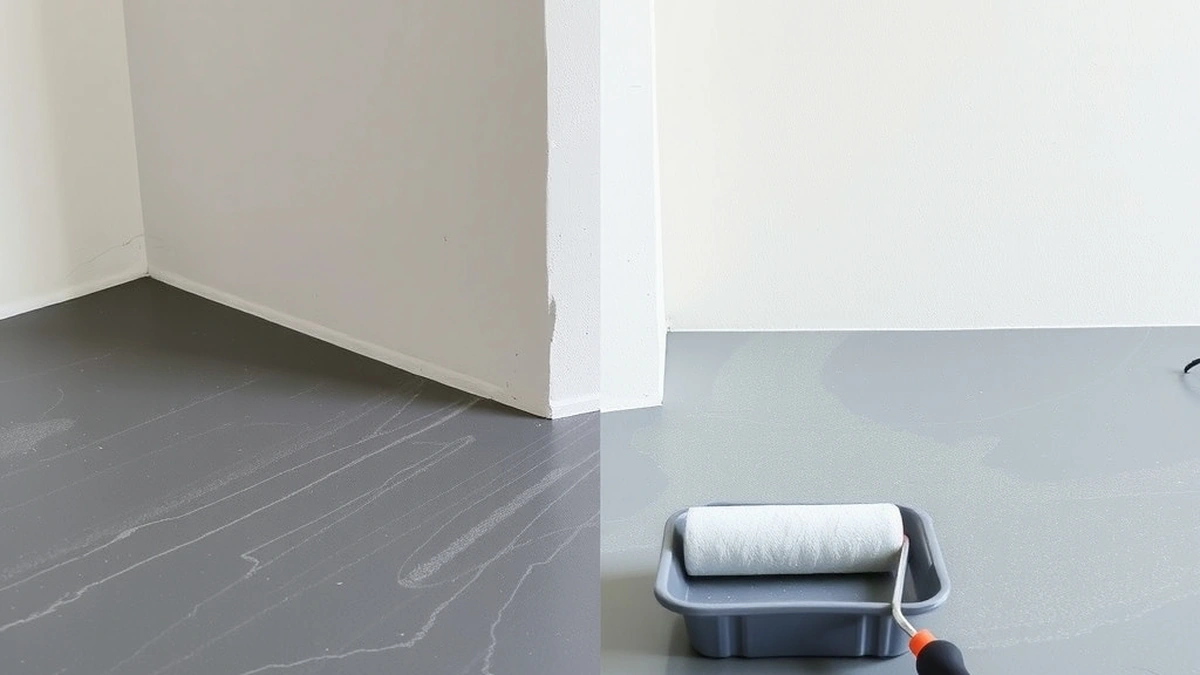
Garage floor paint is a thin single-component coating at about $0.15 to $0.30 per square foot in material. Epoxy is a two-part resin four to ten times thicker, costs $3 to $7 per square foot as a kit, and handles hot tires that paint cannot.
- Paint material
- $0.15 - $0.30 per sq ft
- Epoxy kit
- $3 - $7 per sq ft
- Epoxy installed
- $5 - $12 per sq ft
- Film thickness
- Paint 1-2 mils, epoxy 8-20 mils
Some links on this page are affiliate links.If you buy through them we may earn a commission at no extra cost to you. We do not accept payment for rankings. Read the full disclosure.
Garage floor paint is a thin single-component coating that costs about $0.15 to $0.30 per square foot in material and typically needs attention within a few years. Epoxy is a two-part resin applied four to ten times thicker, costs $3 to $7 per square foot as a kit or $5 to $12 installed, and handles hot tires, road salt and dropped tools that paint does not. The choice is less about price than about what the floor has to survive.
The chemistry, in one paragraph each
Garage floor paint is a coating that forms a film when its carrier evaporates. Most products sold under that name are acrylic, latex or a one-part “epoxy paint” that contains epoxy resin but no hardener. The dry film is typically 1 to 2 mils thick, roughly the thickness of a business card.
Epoxy is a thermoset. Two components, resin and hardener, are mixed and react chemically to form a crosslinked film that cannot be re-dissolved. A single coat is usually 8 to 12 mils, and a full system with primer, base and topcoat builds 15 to 20 mils or more.
That thickness difference, not the label on the can, explains almost every performance difference in this article.
Paint versus epoxy, side by side
| Factor | Garage floor paint | Epoxy coating |
|---|---|---|
| Material cost | $0.15 - $0.30 per sq ft | $3 - $7 per sq ft as a kit |
| Installed cost | Rarely contracted | $5 - $12 per sq ft |
| Film thickness | 1 - 2 mils | 8 - 20 mils |
| Cure | Hours to touch, days to harden | 12 - 24 hours between coats |
| Hot tire resistance | Poor to moderate | Good to excellent |
| UV stability | Moderate | Poor without a topcoat |
| Lifespan in a garage | A few years | Considerably longer |
| Repair | Repaint the area | Patch and recoat |
The cost gap is real but smaller than it looks at the register. A $45 can covers 300 sq ft in one coat, and two coats on 400 sq ft needs about 2.7 gallons, so the material is $60 to $120. An epoxy kit at $3 per square foot for the same floor is $1,200. That is ten times the material cost for a film ten times thicker, applied over prep that the paint project usually skips.
The prep requirement is where paint projects fail
Paint manufacturers ask for a clean, dull, dry surface. Epoxy requires a mechanical profile, which is why grinding at $1 to $3 per square foot appears in every professional epoxy quote.
On a 400 sq ft slab, grinding is $400 to $1,200. That line is the reason a DIY epoxy project costs more than a paint project even before the resin. It is also the reason the epoxy stays down.
Three prep failures wreck a paint job specifically:
Sealer. Many garage slabs were sealed at construction. Paint bonds to the sealer, the sealer lets go of the concrete, and the floor peels in sheets within a season.
Oil. Detergent lifts surface oil but not the oil soaked into the pores. Paint over it and the coating releases in those exact spots.
Moisture. A slab passing vapor blisters any coating, but a thin acrylic film blisters faster and larger than a thick epoxy system with a primer.
Epoxy is not immune to any of the three. It is simply less likely to fail on a slab that was properly ground, because the bond is mechanical and the film is thick enough to bridge minor variation.
Where paint is the right answer
Paint is not a bad product. It is a bad product for a working garage floor, and a reasonable one for three situations.
A rental or a house you are selling in two years, where a $150 refresh is the whole point and the next owner will repaint anyway. A storage shed or a utility room floor that sees foot traffic and no vehicles. A slab that is already failing structurally, where spending $5 to $12 per square foot on a coating is money into a floor that needs concrete work instead.
For anything with a car parked on it, the arithmetic tilts toward epoxy. Tire pickup is the specific failure: warm rubber softens a thin acrylic film, sticks to it, and lifts it when the car pulls out. Once that starts, the floor looks worse than the bare concrete did.
Hot tires and the topcoat question
Even within epoxy, the topcoat decides how the floor handles tires and sunlight. A standard epoxy topcoat resists hot rubber but ambers under UV. A polyaspartic topcoat resists both, at $8 to $15 per square foot as a system rate.
If the garage door faces south and the apron gets sun, the ambering shows within a couple of years on an epoxy clear coat. It is cosmetic, not a failure, but it is the complaint most often reported by owners who chose the cheapest topcoat.
How to choose in six steps
- Decide what parks on the floor. Nothing heavier than a bicycle means paint is defensible. A daily driver means epoxy.
- Test the slab for moisture. Tape a 2 ft square of plastic down for 24 hours; condensation or a dark patch means the slab is passing vapor and neither product will bond.
- Check for sealer. Drop water on the concrete. If it beads instead of soaking in, there is a sealer and it has to be ground off.
- Budget the prep, not just the product. Grinding at $1 to $3 per square foot is $400 to $1,200 on a 400 sq ft floor.
- Pick the finish for the flaws. Flake hides stains and patches; a solid color shows every one.
- Plan the cure. Paint is walkable in a day; epoxy needs three to seven days before parking.
If you are leaning toward the resin, DIY epoxy garage floor covers the tools and the sequence, and epoxy cost separates kit pricing from a contracted install. For the same comparison written around a full painting project, read garage floor painting vs epoxy.
To judge how long either finish will last in your climate, how long does epoxy garage floor last is the next read.
Frequently asked questions
Is garage floor paint the same as epoxy?
No. Most garage floor paint is an acrylic or one-part coating that dries by solvent or water evaporation. Epoxy is a two-part thermoset that cures by chemical reaction and builds a much thicker film.
Will paint hold up to hot tires?
Often not. Tire pickup is the most common complaint against single-part floor paint, because a thin acrylic film softens and sticks to warm rubber. Epoxy resists it far better, and a polyaspartic topcoat resists it best.
How much does it cost to paint a 400 sq ft garage floor?
Material is roughly $60 to $120, based on two coats at about 300 sq ft per gallon and $25 to $45 per gallon. That is $0.15 to $0.30 per square foot before any prep or tools.
Can I put epoxy over garage floor paint?
Only if the paint is fully bonded and mechanically abraded. If it peels, lifts or was applied over a sealer, it has to come off. Epoxy over a weak paint layer fails with the paint.
Which lasts longer, paint or epoxy?
Epoxy, generally by several years. A painted garage floor in daily use typically needs attention within two to four years; an epoxy system with a topcoat is commonly expected to last far longer before a recoat.
Do both need the same surface prep?
Both need a clean, sound, dry slab, but epoxy needs a mechanical profile that paint does not. Grinding at $1 to $3 per square foot is standard for epoxy and is the step most paint projects skip.
Sources
Some links are affiliate links.If you buy through them we may earn a commission at no extra cost to you. We do not accept payment for rankings. Read the full disclosure.