Peeling: repair options
Why epoxy peels, how to tell a topcoat peel from a base coat failure, and the three repair routes with the prep each one requires.
Peeling epoxy is repaired by removing every loose edge, grinding or sanding back to sound material, cleaning, priming and recoating. If the base coat has separated from the concrete, the floor needs a full grind and rebuild rather than a topcoat.
- First step
- Test the bond with a scraper
- Topcoat peel fix
- Sand, prime, recoat
- Base peel fix
- Grind and rebuild
- Grinding rate
- $1 - $3 per square foot
Some links on this page are affiliate links.If you buy through them we may earn a commission at no extra cost to you. We do not accept payment for rankings. Read the full disclosure.
Peeling epoxy is repaired by cutting back every loose edge to sound material, profiling the surface, cleaning it, and recoating. The repair route depends on which bond failed: a topcoat that has separated from the base is a localized fix, while a base coat that has released from the concrete means the floor has to be ground back and rebuilt.
Two different failures, one symptom
Peeling is a symptom, not a diagnosis. The first question is where the separation happened.
If the film comes away and leaves a smooth, grey concrete surface underneath, the base coat released from the slab. That is an adhesion failure at the concrete interface, and it is usually caused by inadequate grinding, moisture, or contamination.
If the film comes away and leaves the base color intact underneath, the topcoat released from the base. That is an inter-coat adhesion failure, typically caused by a missed recoat window, a glossy surface that was not scuffed, or amine blush between coats.
The two require different repairs, and treating an interface failure as a topcoat problem wastes money.
The diagnosis that decides the repair
| Test | Result | Meaning |
|---|---|---|
| Scraper under the edge | Film lifts with concrete attached | Base-to-slab failure |
| Scraper under the edge | Film separates within the coating | Topcoat-to-base failure |
| Coin tap | Hollow, drummy sound | Delamination over a wide area |
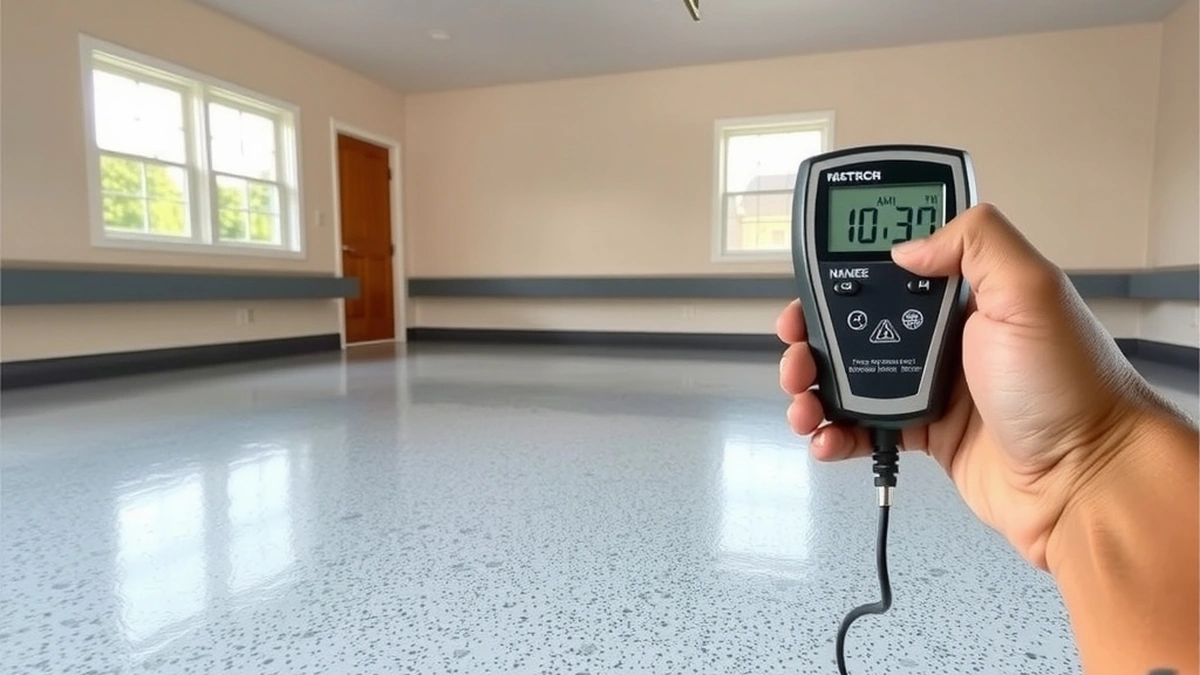
| Moisture test | High emission | Vapor pressure is the cause |
| Visual check | White bloom at edges | Moisture or amine blush |
Do the scraper test in three places, not one. A localized peel at a garage door threshold is often an edge-prep issue, while peeling across the middle of the floor points to the slab.
Repairing a topcoat peel
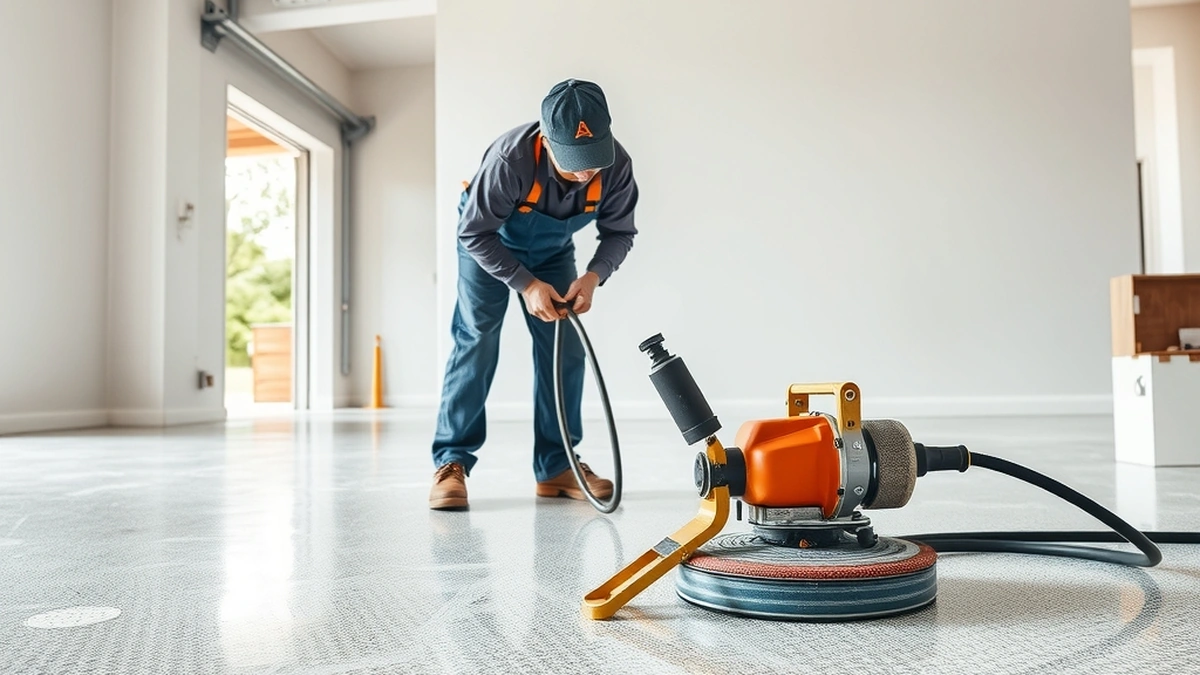
- Score the perimeter of the peeling area with a utility knife, then scrape back to film that is firmly bonded.
- Sand the exposed base and the feathered edge with 80 to 120 grit until the transition is smooth to the touch.
- Vacuum the dust, then wipe with a compatible solvent and let it flash off.
- Apply a compatible epoxy primer or tie coat over the exposed base.
- Recoat with the topcoat in two thin passes, overlapping the feathered edge.
- Keep traffic off for 24 hours and vehicles off for 48 to 72 hours.
The feathering step is what most DIY repairs skip. A repair with a hard edge catches a squeegee, a tire, or a hose and peels from that line.
Repairing a base coat failure
A base peel cannot be patched. The whole film has to come off, because if one area released, the rest is suspect.
Grinding at $1 to $3 per square foot removes the coating and opens the concrete. On a 400 square foot garage, that is $400 to $1,200. Then the slab is tested for moisture, repaired, and coated again at the full system rate of $5 to $12 per square foot.
If the moisture test comes back high, mitigation at $2 to $5 per square foot is added. On 400 square feet, that is $800 to $2,000. Skipping it reproduces the peel.
Why repairs fail
The repeat failures follow three patterns. The repair was applied over a damp slab, so the new film released the same way the old one did. The repair was applied over a contaminated surface, so it bonded to oil rather than concrete. The repair was applied too thick, so the film stayed soft and lifted under load.
A fourth pattern is compatibility. A topcoat applied over an unknown base may not bond, especially if the base was a water-based epoxy or a product with a different chemistry. When in doubt, a small test patch in an out-of-sight corner answers the question for a few dollars.
There is also a recoat-window problem that shows up months later. Epoxy that has fully cured has a glossy, unreactive surface, and a new coat applied over it without sanding bonds weakly. The repair looks perfect for a season and then releases as a sheet, which is why scuffing is never optional even when the floor feels rough.
When to repair and when to replace
Repair makes sense when the peel is under roughly 10 percent of the floor, the base is bonded elsewhere, and the moisture test is normal. Replace when the peel is widespread, when the base is hollow across large areas, or when moisture mitigation was never done.
The cost comparison is stark. A spot repair on 40 square feet uses a small kit at the DIY rate of $5 per square foot, or $200, plus a weekend of work. A full replacement on 400 square feet is $2,000 to $4,800 plus grinding. The repair is worth attempting when the diagnosis supports it.
What to check before approving a repair
Ask the contractor to state which bond failed and how they tested it. Ask whether moisture was measured and what the number was. Ask what primer goes over the exposed base and whether it is compatible with the existing coating.
A quote that says “scrape and re-coat” without naming the failure is a guess. The peeling cost breakdown shows what each route should cost, the prevention guide explains how to keep the repair from repeating, and the warning signs guide covers what to photograph before any work starts.
Frequently asked questions
Can peeling epoxy be repaired without grinding?
Only if the peel is confined to the topcoat and the base is bonded. Even then the area must be sanded and feathered, not just painted over.
Why does epoxy peel in sheets?
The bond failed across a wide area, usually because the slab was not ground, was damp, or had a contaminant such as cure agent or adhesive residue on the surface.
What is the difference between peeling and flaking?
Peeling is a sheet or patch lifting from the layer below; flaking is small brittle pieces breaking away. Peeling points to a bond failure, flaking to a brittle or over-thick film.
How do I know if the base coat is bonded?
Press a scraper under the edge and lift. If the film comes away with a clean concrete surface underneath, the base released from the slab. If it separates within the coating, it is a topcoat peel.
Will a repair hold over a peeling floor?
A repair holds when all the loose material is removed and the sound area is profiled. A patch applied over a moving edge will lift again within a season.
How long should a repaired floor last?
A properly repaired floor with a urethane topcoat typically lasts as long as a new system, provided the moisture issue that caused the peel was addressed.
Sources
Some links are affiliate links.If you buy through them we may earn a commission at no extra cost to you. We do not accept payment for rankings. Read the full disclosure.