Peeling: how to prevent it
The four causes of peeling epoxy and the prep steps that prevent them: grinding, moisture testing, recoat windows and compatible products.
Peeling is prevented by grinding the slab at $1 to $3 per square foot, testing moisture before coating, respecting the manufacturer's recoat window, and scuffing a fully cured coat before the next layer. Most peels are bond failures that start before the first coat is opened.
- Key step
- Diamond grind, not acid etch
- Moisture test
- Before any coating
- Recoat window
- 8 - 24 hours, then scuff
- Mitigation cost
- $2 - $5 per square foot
Some links on this page are affiliate links.If you buy through them we may earn a commission at no extra cost to you. We do not accept payment for rankings. Read the full disclosure.
Peeling is prevented before the first coat is mixed, not after. Grinding the slab, testing moisture, respecting the recoat window, and scuffing a fully cured film are the four controls that decide whether the coating bonds. A floor that peels in sheets had a bond problem from day one; a floor that peels in small flakes after a decade had a wear problem.
What peeling actually is
Peeling is a separation at an interface: either between the coating and the concrete, or between two coats. The film is not worn out in either case. It has lost its grip.
That distinction matters because prevention targets the interface. Surface preparation and moisture control protect the concrete-to-coating bond; recoat timing and scuffing protect the coating-to-coating bond. A floor can fail at either one.
Control one: grind, do not etch
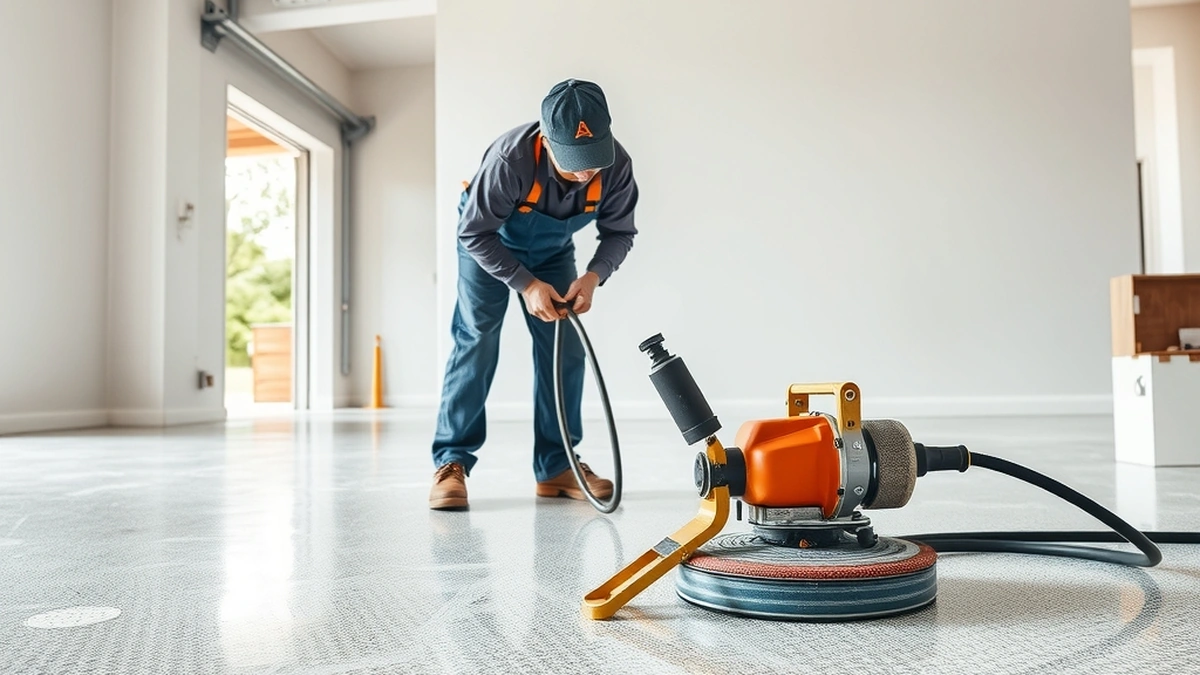
Diamond grinding at $1 to $3 per square foot removes cure agents, sealers, paint, adhesive, and the laitance layer that sits on a new slab. It also opens the concrete’s pores so the epoxy can key into the surface mechanically.
Acid etching is sometimes offered as a cheaper substitute. It does open the surface, but it does so unevenly, and the residue has to be neutralized and rinsed thoroughly. Any residue left behind is a bond breaker, which is the opposite of what the etch was supposed to achieve.
A grinder with a dust shroud and a HEPA vacuum also leaves the floor clean, which etching does not. On a 400 square foot garage, grinding at $2 is $800, and it is the cheapest insurance in the project. The same pass also reveals hollow spots and cracks that would otherwise be hidden under a new coat.
Control two: test and control moisture
Moisture vapor pushing up through a slab is the most common cause of a base coat releasing in sheets. The vapor pressure builds at the interface until the bond fails, and the film lifts from the middle outward.
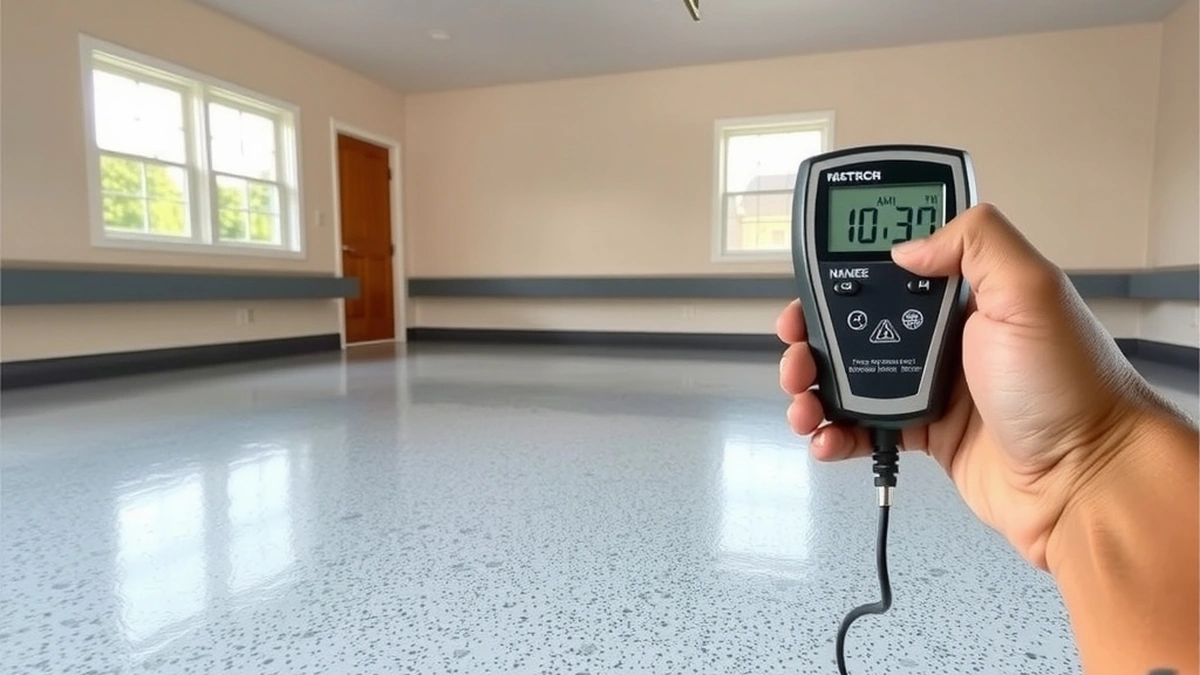
Test before coating. A calcium chloride test or an in-situ relative humidity probe gives a number the contractor can record. A plastic sheet taped down for 24 hours is a field check, not a substitute for a measured test.
Where the reading is high, mitigation at $2 to $5 per square foot is the fix. On 400 square feet that is $800 to $2,000, and it is the difference between a floor that holds and one that peels in the first humid season.
Control three: respect the recoat window
| Situation | Action | Why |
|---|---|---|
| Within 8 - 24 hours | Apply next coat directly | Chemical bond still available |
| After 24 hours | Scuff with 80 - 120 grit | Surface has cured and gone unreactive |
| After a week | Scuff, clean, and prime | Full cure, no chemical bond |
| Over an unknown coating | Test patch first | Compatibility is unknown |
The window varies by product and temperature. A 70°F garage gives a longer window than an 85°F one. Read the data sheet rather than assuming a standard.
Missing the window is not fatal, but it changes the process. Once the film has cured, the next coat needs a mechanical key, which means sanding the whole surface. A recoat applied over a glossy, unscuffed floor may look perfect and then release as a sheet months later.
Control four: keep contamination out
Oil, grease, silicone, curing compounds, and even some cleaning products leave a film that prevents adhesion. Grinding removes most of it, but the dust has to be vacuumed rather than swept, and the floor should be wiped with a compatible solvent before coating.
Tools matter too. A roller cover that has been stored in a dusty shop, a bucket that held an incompatible product, or a pair of shoes that walked through the lawn all transfer contamination. Dedicated tools and clean footwear are cheap controls. So is a simple rule: nothing touches the prepared slab except the coating, the roller, and clean shoes.
A prevention checklist
- Grind the full slab, including edges, and vacuum with a HEPA filter.
- Test moisture and record the result; mitigate where needed.
- Repair cracks and spalls with an epoxy patch and let it cure.
- Apply the base coat at the specified film thickness, not thicker.
- Respect the recoat window, or scuff if it has closed.
- Apply the topcoat in two thin passes rather than one heavy one.
- Keep traffic off for 24 hours and vehicles off for 48 to 72 hours.
What prevention costs against repair
A 400 square foot floor at $8 per square foot is $3,200, plus grinding at $2, or $800, for $4,000. A urethane topcoat sits at the upper end of the coating range but adds little relative to the total.
A repair runs $200 to $600 for a spot and $2,000 to $4,800 for a full recoat on the same floor. A grind-and-rebuild is $2,800 to $6,000. The prevention spend is a fraction of the repair spend, and it happens once.
If the floor is already peeling, the repair options guide explains how to identify which bond failed, the cost breakdown shows the arithmetic for each route, and the warning signs guide covers what to photograph before work begins. For the installation sequence that puts these controls in order, see the epoxy garage floor installation guide.
Frequently asked questions
Does acid etching prevent peeling?
It is less reliable than grinding. Etching opens the surface unevenly and leaves residue that must be neutralized and rinsed, and residue is itself a bond breaker.
Why does epoxy peel after a few months?
Usually moisture vapor or contamination at the slab interface. A film that peels in months rather than years points to a bond failure, not wear.
What is a recoat window?
The time during which a fresh coat can accept the next layer without sanding. After it closes, the surface must be scuffed to give the new coat a mechanical key.
Should I prime the concrete before the base coat?
On porous or damp slabs, a compatible epoxy primer helps. It is not a substitute for grinding, and it must be the manufacturer's specified primer.
Can peeling be caused by applying too thick a coat?
Yes. A thick film can skin over while the material underneath is still soft, which produces poor adhesion and can lead to lifting or blistering.
How do I test whether a slab is dry enough?
A calcium chloride test or an in-situ relative humidity probe gives a number. A plastic sheet taped down for 24 hours gives a rough indication of vapor movement.
Sources
Some links are affiliate links.If you buy through them we may earn a commission at no extra cost to you. We do not accept payment for rankings. Read the full disclosure.