Peeling: warning signs
How to spot peeling epoxy early: lifted edges, hollow sounds, white bloom at the perimeter and the difference between peeling, flaking and blistering.
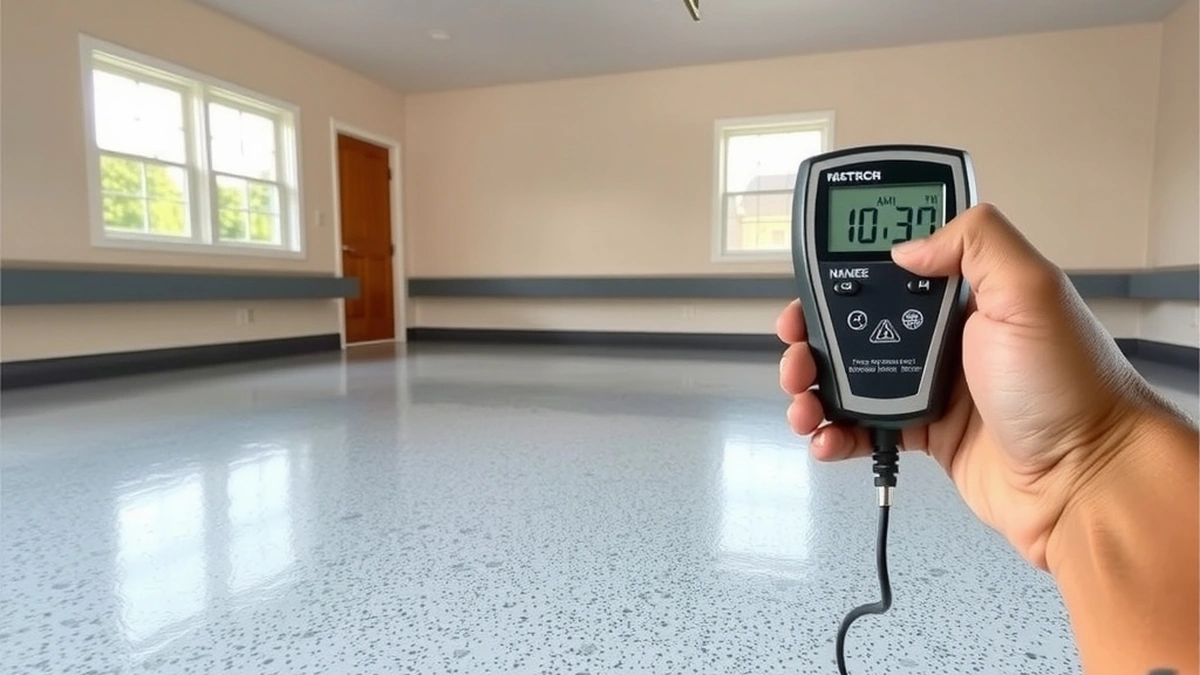
The first sign of peeling epoxy is an edge that lifts under a fingernail, usually at a door threshold, a crack, or the stem wall. A hollow sound under a coin tap and white bloom along the edge confirm that the bond has failed rather than the surface being scuffed.
- Earliest sign
- Edge lifts under a fingernail
- Confirming sign
- Hollow sound under a coin tap
- Common location
- Thresholds and stem walls
- Repair trigger
- Peel wider than a few inches
Some links on this page are affiliate links.If you buy through them we may earn a commission at no extra cost to you. We do not accept payment for rankings. Read the full disclosure.
Peeling epoxy gives warning before a sheet comes up. The first sign is an edge that lifts under a fingernail, usually at the garage door threshold or along the stem wall, followed by a hollow sound when the area is tapped. Those two checks take a minute and tell you whether the bond has failed while the repair is still small.
The edge test
Run a fingernail, a plastic scraper, or a putty knife along the perimeter of the coating. A sound floor has an edge that sits tight against the concrete or the wall. A failing floor has a lip that lifts a millimeter or two and does not spring back.
Test at the door threshold first, then the stem walls, then around any crack. Those are the three places preparation is hardest and moisture collects.
If the lip lifts and the concrete underneath is clean and grey, the base coat has released. If the lip lifts and the base color is intact underneath, the topcoat has separated from the base. The second is a smaller repair.
The sound test
Tap the floor with a coin, a screwdriver handle, or a knuckle. A bonded coating gives a sharp, solid click. A delaminated area gives a flat, hollow, drummy sound.
Move in a grid, about 2 feet apart, and mark the hollow spots with tape. A single hollow spot near a crack is common and repairable. A grid of hollow spots across the floor means the system has failed over a large area.
The sound test finds peeling before it is visible, which is the point. A hollow area that still looks perfect will lift within a season.
The visual signs, ranked
| Sign | What it looks like | Urgency |
|---|---|---|
| Edge lip | Coating slightly raised at a wall or threshold | Low, repair within the year |
| Dull patch that will not clean | Matte area with no gloss | Low, investigate |
| White bloom at the edge | Chalky white deposit along the lift | Medium, moisture suspected |
| Visible sheet lifting | Coating curled back with concrete exposed | High, repair now |
| Cracking along the lift line | Coating splits as it curls | High, repair now |
| Rust staining under the film | Orange-brown marks at the edge | High, moisture and corrosion |
White bloom is worth attention because it often appears before the peel. It is efflorescence, salt pushed to the surface by moisture moving through the slab, and it signals the vapor problem that later lifts the coating.
Peeling, flaking, and blistering
These three are often used interchangeably and they are not the same.
Peeling is a sheet or patch lifting from an edge. It points to an adhesion failure at an interface.
Flaking is small, brittle pieces breaking away, usually from an over-thick or over-hard film. It points to a coating that has lost flexibility rather than a bond failure.
Blistering is a raised bubble with a soft top, usually in the middle of a floor. It points to moisture vapor pushing from below.
The repair differs for each. Peeling needs removal of the loose material and a recoat; flaking may need the whole film sanded back; blistering needs the moisture source addressed first.
Why edges fail first
The perimeter of a slab is where a large grinder cannot reach. Contractors use a hand grinder with a diamond cup wheel along the stem wall, and if that step is rushed, the edge is the only part of the floor that was not properly profiled.
Edges also collect water. Rain blows in under the garage door, snow melt pools at the threshold, and the concrete at the perimeter is often the first place to show dampness.
That is why a peel that starts at the door and spreads inward is usually an edge-prep or moisture problem, while a peel in the middle of the floor points to the slab as a whole. The pattern of the damage is a map of the cause, and it is worth sketching on a sheet of paper before you call anyone.
When to call a contractor
Call when the peel is wider than a few inches, when the edge crumbles instead of lifting cleanly, when several separate areas are lifting, or when white bloom appears with the lift.
A small edge peel under 2 inches can be monitored and repaired in a planned way. A peel that has exposed concrete over a square foot, or that has begun to curl, needs removal and recoating before traffic spreads the damage. In the meantime, keep the car off the affected area and do not sweep grit across the lifted edge, because grit works its way under the film and extends the failure.
Documenting before the repair
- Photograph each lifted edge with a tape measure in frame.
- Photograph the wider area to show how much floor is affected.
- Note any white bloom, damp patches, or rust staining.
- Record the date the sign first appeared.
- Test moisture before any repair is scheduled.
- Keep the original installer’s specification and warranty documents.
A contractor can price from those five items more accurately than from a phone description, and the moisture result decides whether the repair is a recoat or a rebuild.
For the repair sequence, see peeling repair options. For the costs, read the peeling cost breakdown, and for the controls that prevent a repeat, check how to prevent peeling.
Frequently asked questions
What are the first signs of peeling epoxy?
A slight lip at the edge of the coating, a dull patch that will not clean, and a hollow sound when the floor is tapped. These appear before a visible sheet lifts.
Where does peeling usually start?
At the garage door threshold, along the stem walls, and around cracks. Those are the places where preparation is hardest and where moisture and traffic concentrate.
How is peeling different from blistering?
Peeling lifts from an edge and spreads; blistering raises a bubble in the middle of the film. Both are bond failures, but blistering usually points to moisture vapor.
Can a peeled edge be sealed back down?
No. Once the bond has failed, adhesive cannot restore it. The loose material has to be removed and the area recoated.
Does peeling always mean the whole floor will fail?
Not always. A localized peel at an edge can be repaired and the rest of the floor may be sound. Widespread peeling or hollow patches mean the system is failing.
What should I photograph before calling a contractor?
The lifted edge with a tape measure in frame, the area around it, and any white bloom or damp patches. Those images let a contractor price the work accurately.
Sources
Some links are affiliate links.If you buy through them we may earn a commission at no extra cost to you. We do not accept payment for rankings. Read the full disclosure.