Polyaspartic maintenance: a cleaning routine
Polyaspartic maintenance is simple but not optional: sweep grit, wash with a pH-neutral cleaner, manage salt in winter and recoat before the film wears through.
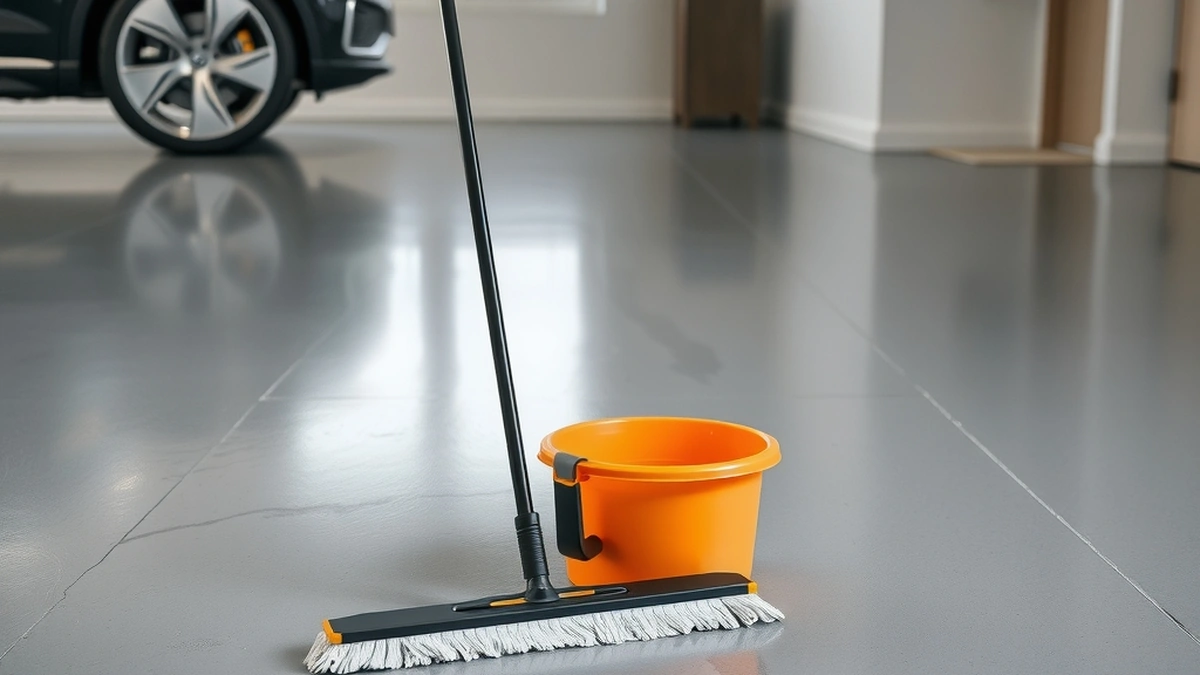
Polyaspartic maintenance takes about 20 minutes a week: sweep or blow out grit, mop with a pH-neutral cleaner and water, and rinse salt off in winter. The coating resists chemicals but not abrasion, so grit left under tires does more damage than any spill.
- Weekly time
- About 20 min
- Cleaner
- pH-neutral
- Full system cost
- $8-15 / sq ft
- Salt season rinse
- Weekly
Some links on this page are affiliate links.If you buy through them we may earn a commission at no extra cost to you. We do not accept payment for rankings. Read the full disclosure.
Polyaspartic maintenance is mostly sweeping. The topcoat is hard, chemically resistant and non-porous, so spills wipe up and soapy water does no harm; what wears it out is fine grit ground under tires and road salt left to sit. Twenty minutes a week keeps the surface intact, and the routine costs less than a single service call.
What the finish actually tolerates
Polyaspartic is an aliphatic polyurea topcoat, a hard, glossy film that resists water, most automotive fluids and household chemicals while staying color-stable under UV.
That resistance has limits worth knowing. It handles brake fluid, oil, coolant and road salt as spills; it does not handle strong solvents, paint stripper or a degreaser left to pool. It resists abrasion well; it does not resist sharp metal, dropped tools or a jack dragged across the floor. And it resists UV; it does not resist a pressure washer aimed at an edge.
The coating is the wear layer of a system that cost $8 to $15 per square foot to install, so the goal of maintenance is to protect the most expensive part of the floor from the cheapest threats.
The routine, by interval
| Interval | Task | Time |
|---|---|---|
| Weekly | Sweep or blow out grit, leaves and sand | 10-20 min |
| Monthly | Mop with a pH-neutral cleaner and warm water | 20-30 min |
| Seasonal | Wash the full floor, check edges and seams | 1-2 hours |
| Twice a year | Move shelving and clean underneath | Half a day |
| Annually | Inspect for wear, chips and dull patches | 30 min |
The weekly item is the one that matters. Grit is abrasive, and every time a car rolls over a patch of sand the film loses a little thickness at that spot. Over a decade that is the difference between a floor that takes a refresh coat and one that needs grinding back to concrete.
Grit is the real enemy
Sand, road grit and the gravel from a winter driveway act like sandpaper under a tire. The damage is concentrated where the wheels track, which is why a garage floor often shows two dull bands before anything else looks worn.
Two cheap countermeasures do most of the work. A walk-off mat at the door catches grit before it reaches the coating, and a dust mop or leaf blower once a week clears what gets past it. Neither is maintenance in the technical sense, and together they add years to the topcoat.
Sharp objects are the second category. Dropped wrenches, dragged jacks, and the feet of a metal shelving unit all chip a hard film. Felt pads under furniture legs and a plywood pad under a jack cost almost nothing.
Road salt and winter
De-icing salt is the hardest thing a garage floor sees in a northern climate. It arrives as brine on the tires and the wheel wells, dries into a white film, and sits in the texture of the flake where a broom cannot reach it.
Rinse it off. A bucket of warm water and a mop across the wheel tracks once a week during salt season is enough, and a full wash after the last snow is worth doing. Salt left on the surface holds moisture against the film and dulls the gloss long before the coating is worn.
Calcium chloride is more aggressive than sodium chloride and often leaves a greasy residue that only a proper cleaner lifts. Use the pH-neutral cleaner at full strength for that, not a stronger solvent.
Cleaning products: what to use
| Product | Verdict | Why |
|---|---|---|
| pH-neutral floor cleaner | Best default | Lifts dirt without attacking the film |
| Mild dish soap and water | Fine for spot work | Cheap and safe when rinsed |
| Degreaser, diluted | Occasional use | Full-strength or pooled, it softens the gloss |
| Citrus or solvent cleaner | Avoid | Attacks the film and dulls the finish |
| Bleach or high-pH cleaner | Avoid | Leaves a haze and can stain flake |
| Melamine sponge | For scuffs | Mildly abrasive, so use it lightly |
The general rule: if the product is designed for a sealed hard floor, it is probably fine. If it is designed to strip a floor, it is not.
Recoating before the film fails
A polyaspartic topcoat is a wear layer, and wear layers get replaced. The sign that a refresh is due is a floor that has gone from glossy to flat in the traffic lanes, or a surface that no longer beads water in the middle of the garage.
A refresh coat costs a fraction of the $8 to $15 per square foot full-system rate, because it is one layer over a floor that is already ground, repaired and coated. That estimate depends on the crew and the square footage, but the comparison that matters is simple: a refresh costs far less than the grind and rebuild required once the base coat is exposed.
Timing is the whole skill. Recoat while the topcoat is intact and the new film bonds to a clean, abraded surface. Wait until the base coat shows through and the job becomes a full system again, at full system prices.
Five steps to a maintenance routine that holds
- Put a mat at the door. A walk-off mat is the cheapest wear protection you can buy, and it keeps grit off the coating.
- Sweep weekly, not monthly. Ten minutes with a broom or blower removes the abrasive that does the real damage.
- Mop with a pH-neutral cleaner once a month. Warm water, a capful of cleaner, a damp mop, and a rinse if the floor is dirty.
- Rinse salt in winter. Clear the wheel tracks weekly during salt season and wash the whole floor once the season ends.
- Inspect every spring. Look at the traffic lanes, the door apron and the stem wall for dull patches, chips and lifting edges, and photograph anything that changes year to year.
When maintenance becomes repair
Cleaning handles dirt, dullness and light scuffing. It does not handle a coating that has lifted, bubbled or lost its bond, and those are the symptoms that call for a different response.
A chip smaller than a coin can be patched with the same product. A patch of bubbles, a blistered area near the door, or a section where hot tire has pulled the film loose means the bond failed, and a patch will spread. Polyaspartic problems works through the diagnosis, and epoxy garage floor repair covers the repair sequence for the base coat underneath.
For the routine that applies to the epoxy base as well, see epoxy garage floor maintenance. If the floor is due for a refresh, polyaspartic cost explains what a full system costs and where a topcoat-only job sits against it, and how long epoxy garage floor lasts puts the recoat interval in context.
Frequently asked questions
How often should a polyaspartic garage floor be cleaned?
Sweep or blow it out weekly, mop monthly with a pH-neutral cleaner, and wash the whole floor twice a year. In winter, rinse road salt off within a day or two of parking, because salt sits in the film and dulls it.
What cleaner is safe on polyaspartic?
A pH-neutral floor cleaner diluted per the label, or a mild dish soap solution. Avoid harsh degreasers, citrus solvents and anything with a high pH sitting on the floor, because they soften the film over time.
Can I use a pressure washer?
A low-pressure unit with a fan tip is safe on a sound coating, but keep the nozzle moving and never point it at a seam, the stem wall or a crack. High pressure drives water under the film at edges, which is where coatings start to lift.
How do I remove tire marks from polyaspartic?
Most transfer marks come off with a melamine sponge and a pH-neutral cleaner. Marks that will not lift at all are usually hot tire pickup, which is a bond failure rather than dirt, and no cleaner fixes that.
Does polyaspartic need a new topcoat eventually?
Yes. The wear layer thins over years of grit and traffic, and a refresh coat restores it. That costs a fraction of the $8-15 per square foot full system, and doing it before the base coat is exposed avoids a full rebuild.
Can I put a polyaspartic topcoat over an existing epoxy floor?
Yes, if the epoxy is sound, clean, and abraded or inside its recoat window. Any area that is lifting or delaminating has to be cut out first, because a new topcoat bonds to the old film and inherits its failures.
Sources
Some links are affiliate links.If you buy through them we may earn a commission at no extra cost to you. We do not accept payment for rankings. Read the full disclosure.