Epoxy problems: causes and fixes
Peeling, bubbles, hot tire pickup and yellowing are the four epoxy problems owners report most. What causes each one and what the repair actually costs.
Most epoxy problems trace to four causes: an unground slab, moisture through the concrete, a film built too thin, and UV exposure. Peeling, blistering, hot tire pickup and yellowing each map to one of those, and the fix runs from a patch to a full regrind.
- Most common failure
- Peeling from weak prep
- Second most common
- Blistering from moisture
- Mitigation cost
- $2 - $5 per sq ft
- Regrind and recoat
- $5 - $12 per sq ft
Some links on this page are affiliate links.If you buy through them we may earn a commission at no extra cost to you. We do not accept payment for rankings. Read the full disclosure.
Most epoxy problems are not product defects. They are four failures with four causes: peeling from a slab that was never ground, blistering from moisture moving through the concrete, hot tire pickup from a film that was built too thin, and yellowing from sunlight hitting a clear coat that was never UV stable. Diagnose which one you have before you buy anything.
The failure map
An epoxy problem is a deviation between how the floor was specified and how it was installed or used. That is why the symptom usually names the cause.
| Symptom | Cause | Fix |
|---|---|---|
| Sheets lifting with dust underneath | Weak profile, sealer, or oil | Regrind and recoat |
| Raised bumps with water inside | Moisture vapor from the slab | Mitigate at $2 - $5 per sq ft |
| Coating stuck to tires | Thin film or no topcoat | Recoat with a proper build |
| Amber or yellow cast | UV exposure on epoxy clear | Polyaspartic clear coat |
| Cracks following the concrete | Coating bridged a moving joint | Route, fill, recoat |
| Dull traffic lane | Abrasion through the wear layer | Clear-coat refresh |
| Soft or tacky patches | Mix ratio error or cold slab | Remove and redo |
| White blush on the surface | Amine blush from humidity | Wash and abrade before topcoat |
Soft patches and amine blush are installation errors that appear within days. The rest develop over months and years, and all of them are cheaper to prevent than to reverse.
Peeling and delamination
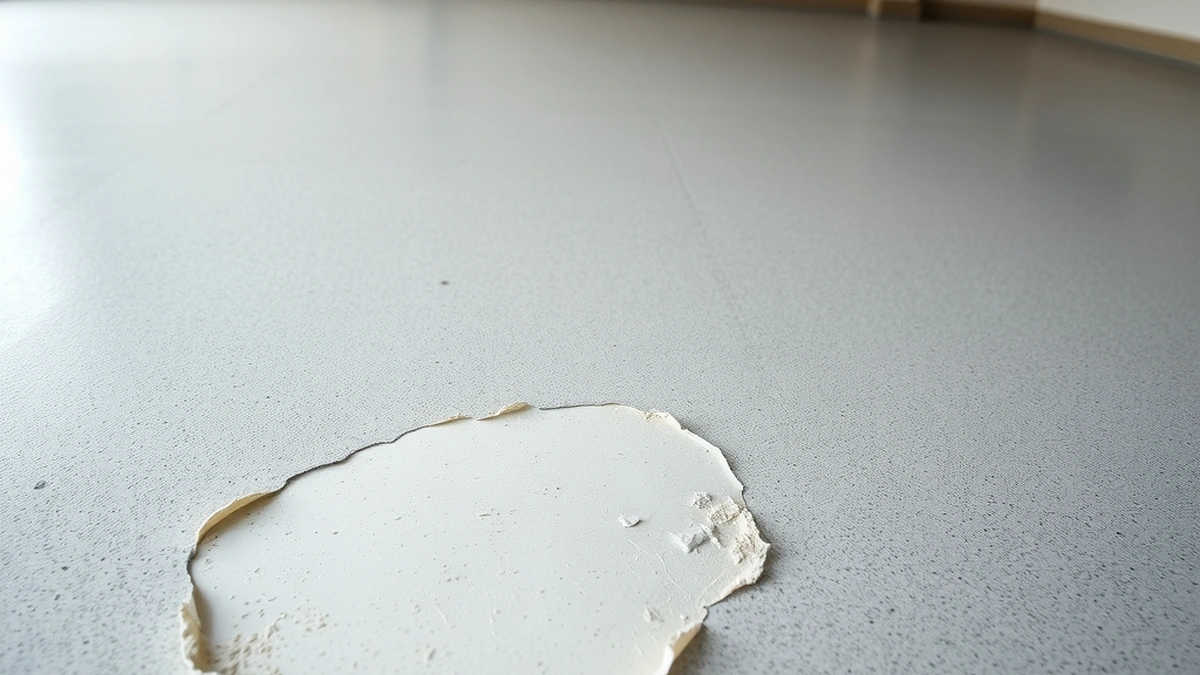
Peeling is the most reported epoxy problem, and it is the least mysterious. The coating did not bond, so it let go.
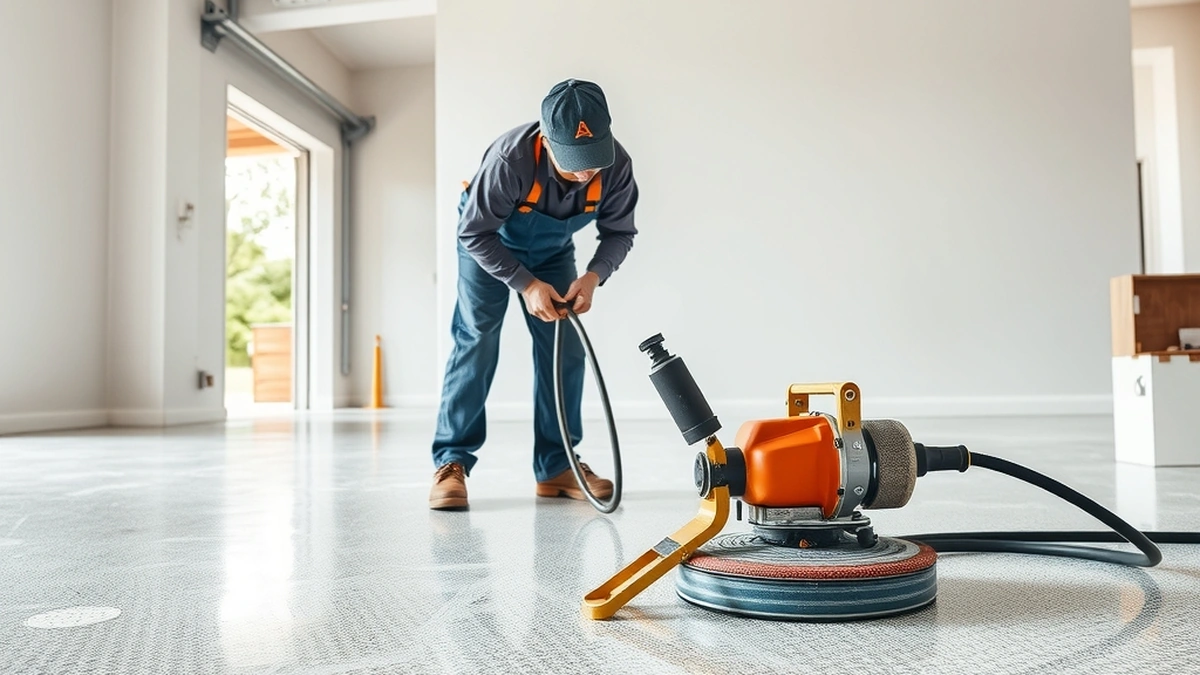
Three conditions cause it. A sealer applied at construction or by a previous owner sits between the concrete and the resin. Oil soaked into the pores repels the primer. A slab that was acid-etched instead of ground has a chemical profile that is uneven and often contaminated with residue.
The tell is what is under the peeled coating. A chalky white dust means the concrete surface was weak or dusty. A glossy, smooth surface means the coating never had a profile to grip. Oil staining means the contamination was never removed.
Repair is not a patch over the top. The loose material comes off, the slab is ground back to sound concrete, and a new system goes down. On 400 sq ft that is $5 to $12 per square foot, or $2,000 to $4,800, which is why the original grinding line at $1 to $3 per square foot was never the place to save money.
Bubbles and blisters
Blisters are gas trapped under a curing film. The gas comes from the slab, and it arrives in two forms.
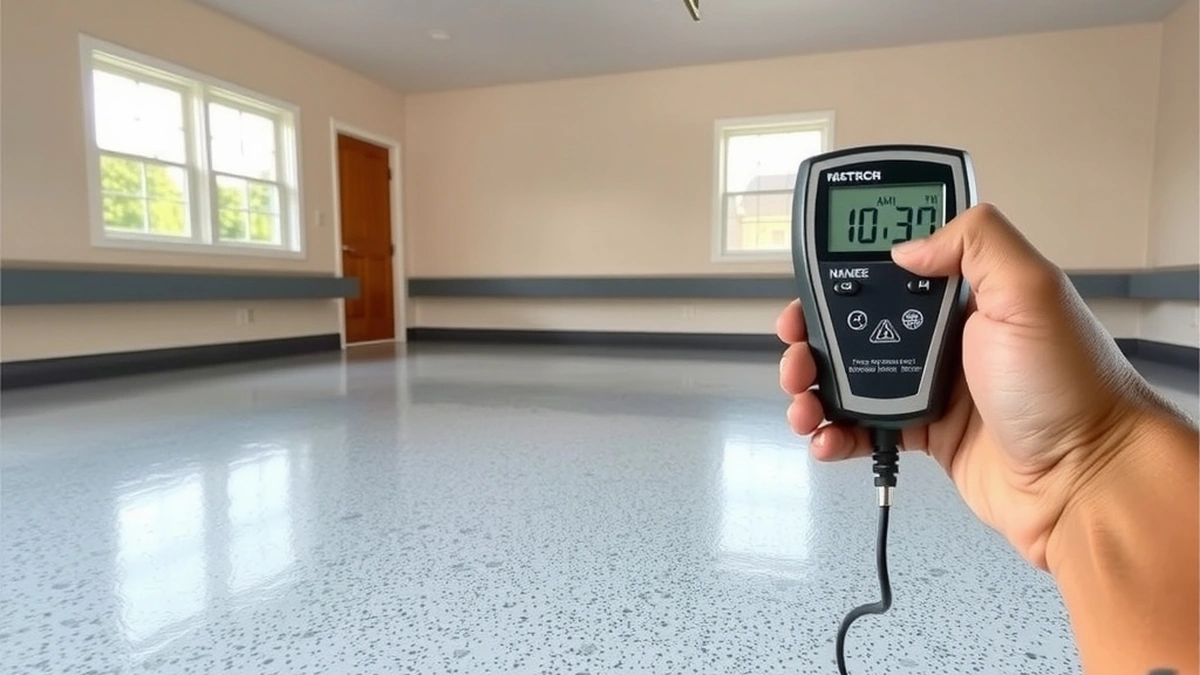
Water vapor is the common one. A slab sitting on wet ground passes moisture upward, and a coating sealed over it traps that vapor until pressure lifts the film. The bubbles are often soft, and some contain water.
Outgassing is the second. Warm concrete releases air as the coating seals the surface, and the gas collects in the film before it hardens. This is why cool mornings are better than hot afternoons for the base coat.
Prevention is a moisture test before the job and a primer that tolerates the slab. Cure is mitigation: a vapor barrier system at $2 to $5 per square foot, which is $800 to $2,000 on 400 sq ft.
Small blisters can be opened, cleaned and filled. A floor covered in them has to come up. Bubbles repair covers the patching method, and bubbles signs explains how to tell blistering from a debris speck.
Hot tire pickup
Hot tire pickup looks like torn patches in the traffic lanes, exactly where the tires sit. The coating has stuck to warm rubber and been lifted as the car pulled out.
The cause is film thickness. A thin coating, or one with no topcoat, softens under a warm tire and bonds to it. Paint fails this way almost immediately; a thin epoxy kit fails within a season or two.
The permanent fix is a proper build with a clear topcoat. Polyaspartic at the top of the system resists warm rubber better than a standard epoxy clear, and it is the specification most installers recommend for a daily-driver garage.
A localized repair is possible if the damage is confined to two tire patches: cut back to sound coating, grind the edges, re-coat and blend. Expect the repair to be visible. A full recoat is the only way to get a uniform finish, and it costs the same $5 to $12 per square foot as the original job.
Yellowing and color drift
Epoxy ambers because aromatic epoxy chemistry reacts to ultraviolet light. The color develops in the clear coat, which is why a grey floor turns a greenish tan near a sunlit door while the middle of the garage stays grey.
This is cosmetic, not structural. The floor is still bonded and still protecting the concrete, and the discoloration does not spread into shaded areas.
The fix is a UV-stable topcoat. A polyaspartic clear goes over a sound, abraded epoxy base and restores the appearance at roughly the cost of a topcoat rather than a full system. Yellowing cost breaks out that number, and the prevention is specifying polyaspartic from the start on any floor that sees sun.
Cracks, chips and wear
Three smaller problems round out the list, and each has a straightforward repair.
Cracks that follow the concrete. A coating is flexible but not a bridge. A working crack reopens and splits the film above it. The fix is to route the crack, fill it with a semi-rigid patch, and coat over it, accepting that the repair line will show.
Chips and gouges. Dropped tools and dragged jacks take pieces out of the film. A patch kit with color-matched resin handles small ones; larger areas need the surrounding coating feathered back.
Dull traffic lanes. Abrasion wears the gloss off the wear path first. This is the signal to refresh the clear coat before the base coat is exposed, and a refresh is far cheaper than a rebuild.
How to diagnose your floor in five steps
- Photograph the damage with a scale. A coin or a tape measure in frame tells a contractor more than a wide shot.
- Test the bond around the damage. Score a 2-inch square with a knife and lift it. If it releases easily, the failure is widespread.
- Check for moisture. Tape a plastic square down for 24 hours and look for condensation, then ask for an in-situ test before any repair spec.
- Identify the layer that failed. Clear coat only means a recoat. Base and primer mean a prep failure. Concrete means a slab problem.
- Get a repair spec, not an estimate. Products, number of coats and the prep method, so two quotes can be compared.
For the repair sequence itself, epoxy garage floor repair walks through patching and blending. Epoxy floor durability explains why the original build failed, and flake broadcast problems covers the decorative-specific faults that look like coating failures but are not.
Frequently asked questions
Why is my epoxy floor peeling?
Almost always a bond failure: the slab was acid-etched instead of ground, a sealer was left in place, or oil remained in the pores. The coating releases in sheets and leaves a chalky dust on the concrete.
What causes bubbles in epoxy flooring?
Gas escaping from the slab while the coating cures. That gas is either water vapor from a slab passing moisture or air expanding as warm concrete is sealed. A moisture test and a primer are the prevention.
How do you fix hot tire pickup on epoxy?
Remove the lifted coating, grind the area back to sound material, and recoat with a system that includes a proper topcoat. A polyaspartic clear resists warm rubber better than a standard epoxy clear.
Why did my epoxy turn yellow?
Aromatic epoxy ambers when UV light hits it. The discoloration is in the clear coat, not the color base, so a recoat with a UV-stable polyaspartic clear restores the appearance without replacing the floor.
Can epoxy problems be fixed without redoing the whole floor?
Sometimes. A localized patch can be repaired and blended, but a color or texture mismatch is usually visible. Widespread peeling or blistering means the whole system has to come off and the slab has to be prepped again.
How much does it cost to fix a failed epoxy floor?
A spot repair is a few hundred dollars. A full regrind and recoat runs $5 to $12 per square foot installed, so a 400 sq ft garage is $2,000 to $4,800, plus $2 to $5 per square foot if moisture mitigation is needed.
Sources
Some links are affiliate links.If you buy through them we may earn a commission at no extra cost to you. We do not accept payment for rankings. Read the full disclosure.