Polyaspartic reviews: how to read them
Polyaspartic reviews split into product and installer feedback. Read the complaints that recur, the prep failures behind them, and what to verify instead.

Polyaspartic reviews are mostly installer reviews, not product reviews. The same four complaints recur: cost at $8-15 per sq ft, a 10-20 minute pot life, visible lap lines, and bubbles from a wet slab. Read them for failure patterns, not for a verdict.
- Polyaspartic system
- $8-15 / sq ft
- Professional epoxy
- $5-12 / sq ft
- Grinding, if skipped
- $1-3 / sq ft
- Moisture mitigation
- $2-5 / sq ft
Some links on this page are affiliate links.If you buy through them we may earn a commission at no extra cost to you. We do not accept payment for rankings. Read the full disclosure.
Polyaspartic reviews are usually reviews of an installer, not of a resin. The product is sold through crews and specialty suppliers, so the person writing the review is describing the sequence of decisions that produced their floor: what was ground, what was tested, how fast the crew moved. The complaints that recur are consistent enough to be useful as a checklist, even though no honest reading of them produces a single verdict.
What reviews can and cannot tell you
A polyaspartic floor is an aliphatic polyurea topcoat applied over a prepared slab and, usually, over an epoxy base coat, installed at $8 to $15 per square foot.
Reviews describe outcomes well. A floor that peeled in eight months, a topcoat that went dull in the wheel tracks, a crew that showed up late — those are reportable facts, and a pattern of them across many reviews is worth weighing.
Reviews describe causes badly. The reviewer rarely knows the slab’s moisture reading, the grinding method, the product’s recoat window, or the dew point on install day. Those four variables explain most failures, and none of them appears in a typical review.
The cost complaint, in numbers
The most common negative theme is price, and it is legitimate. Polyaspartic runs $8 to $15 per square foot against $5 to $12 for a professional epoxy system, a gap of $3 per square foot at both ends of the range.
On a 400 sq ft two-car garage that gap is 400 × $3 = $1,200. Reviewers who feel overcharged are usually reacting to that number without the context of what it buys: UV stability, a faster return to service, and better abrasion resistance.
The reviews worth reading are the ones that name what was included. A $4,000 quote on 400 sq ft is $10 per square foot, mid-band, and whether it is fair depends on whether grinding, repair, primer, base, flake and topcoat were all inside it.
The pot life and lap line complaint
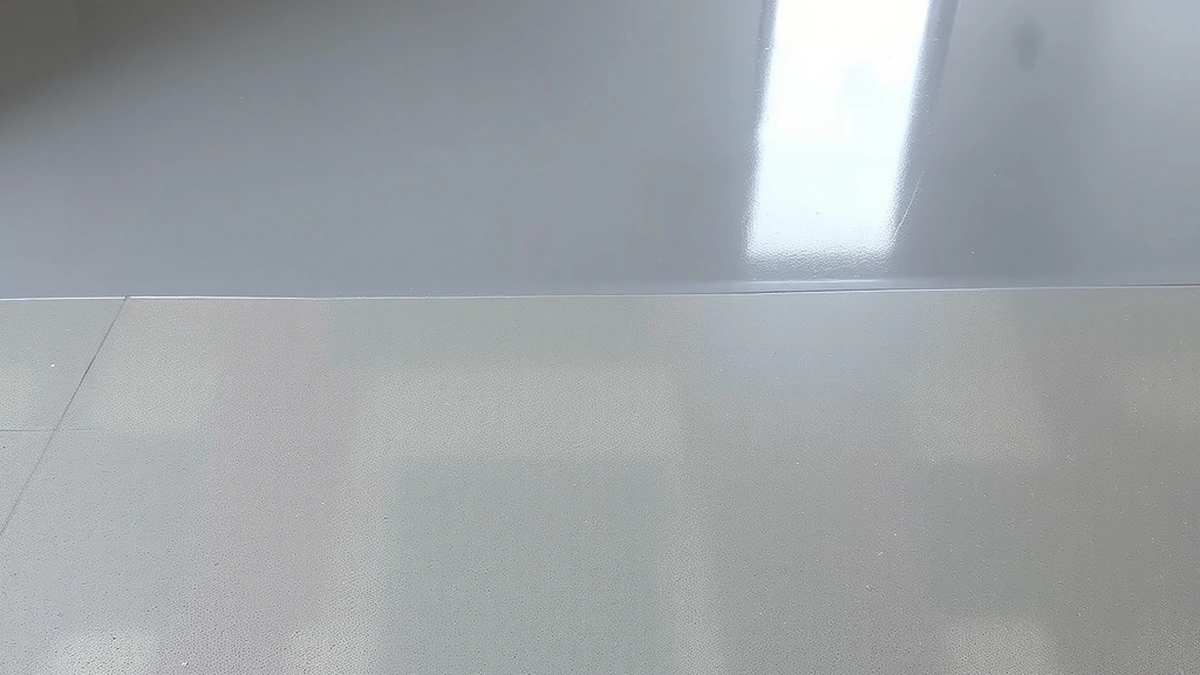
The second recurring theme is visible lines. Polyaspartic can gel in 10 to 20 minutes, and a batch that sits while one person works alone leaves a ridge that the gloss reflects at every angle.
This is the clearest case of a review describing an applicator problem. The chemistry did what it was designed to do; the crew did not staff for it. Two people working in sequence, small batches and a moving wet edge solve it, and reviews from homeowners who hired a two-person crew rarely mention lines at all.
Reviews from people who applied it themselves are the most useful here, because they describe exactly where the batch got away from them.
The complaint that is really prep
Peeling, bubbling and hot tire pickup dominate the low-star reviews, and all three are bond failures. The cause is almost always below the coating:
| What the review says | What probably happened |
|---|---|
| Peeled in sheets after one winter | Grinding skipped, or dust left on the slab |
| Bubbled across the whole floor | Moisture never tested, no mitigation |
| Only the area by the door failed | Condensation or a cold joint |
| Tire marks will not come out | Hot tire pickup on a weak bond |
| Dull patches in the wheel tracks | Grit abrasion, not a product fault |
Grinding costs $1 to $3 per square foot and moisture mitigation costs $2 to $5 per square foot. Those two line items, combined, are $3 to $8 per square foot — comparable to the entire gap between epoxy and polyaspartic. Skipping them to protect the budget is the most expensive decision in the project.
What positive reviews leave out
A five-star review written the week after install is a review of a wet floor. It cannot describe durability, color stability or how the coating handles a winter of salt.
| Review claim | What to verify instead |
|---|---|
| Looks amazing | Ask for a photo of a two-year-old floor |
| Held up great | Ask what the garage is used for and how often |
| No issues at all | Ask whether the slab was moisture tested |
| Best money I spent | Ask for the itemized scope and the rate per sq ft |
| Easy to clean | Ask what happens with road salt in February |
The reviews with the most value are long, specific and slightly boring. They mention the slab’s age, the humidity, the number of coats and a problem that was fixed. Enthusiasm is not evidence.
Five questions for a contractor instead of more reviews
- Show me the moisture test. A plastic sheet test, a calcium chloride test or an in-situ probe reading, documented before the quote was final.
- How will you grind it? Diamond grinding at $1 to $3 per square foot is the answer. A chemical etch or an acid wash is not equivalent, and a quote that specifies one is a warning.
- Which product, and can I see the data sheet? You are looking for solids, pot life, recoat window and application temperature.
- How many people will be on site? A fast system needs more than one pair of hands, and a crew that plans to send one person is planning to leave lap lines.
- Can I see a floor you did two winters ago? Durability is the only claim a new floor cannot make. An installer with older work to show has nothing to hide.
Where the review evidence is strongest
Reviews are strongest on contractor conduct: whether the crew showed up, protected the walls, cleaned up and came back when something went wrong. They are weakest on technical causation, because the reviewer was not present for the decisions that mattered.
Use them that way. Read for patterns in service, then verify the technical side yourself with the data sheet and the moisture test.
For the sequence a good crew follows, see polyaspartic installation. Polyaspartic problems maps the symptoms above to causes, and polyaspartic vs epoxy covers whether the premium is worth paying at all. If price is the sticking point, polyaspartic cost itemizes the $8 to $15 band so you can compare a quote line by line.
Frequently asked questions
Are polyaspartic floor reviews reliable?
Partly. Reviews reliably report what a floor looks like months after install and how a contractor behaved. They do not reliably report why a coating failed, because most reviewers never saw the moisture test result or the recoat timing.
What is the most common complaint in polyaspartic reviews?
Cost and lap lines, in that order. Homeowners are surprised by the $8 to $15 per square foot rate against epoxy at $5 to $12, and installers report ridges where a fast-setting batch was rolled over a cured edge.
Why do some reviews report peeling within a year?
Peeling is a bond failure, and the cause sits under the coating: grinding dust, an old sealer, oil, or moisture the slab never should have been coated over. A coating cannot bond to contamination it was applied on top of.
Should I trust a five-star review with no photos?
Treat it as a data point, not a verdict. A useful review describes the slab, the prep, the timeline and the weather, and shows the floor after at least one winter. Anything shorter is a satisfaction note.
Do polyaspartic reviews mention yellowing?
Rarely, because the topcoat is chosen for UV stability, and most complaints about color come from epoxy floors instead. When yellowing does appear in a review, ask which isocyanate the product used, since not every polyaspartic is equally aliphatic.
How do I check a contractor instead of reading reviews?
Ask for the moisture test record, the grinding method, the product data sheet and the recoat schedule, and ask to see a floor they installed two winters ago. Those four answers tell you more than a star rating.
Sources
Some links are affiliate links.If you buy through them we may earn a commission at no extra cost to you. We do not accept payment for rankings. Read the full disclosure.